A lot of property teams only think about emergency exit lights when something goes wrong. The power blips during business hours. A tenant improvement shifts a corridor. The fire marshal shows up after a complaint. Then someone discovers that the glowing EXIT sign over the door was never the whole system, and the battery unit that looked fine on a quick walk-through can't carry the path long enough to get people out cleanly.
That's where the gap sits in Southern California. Most articles stop at “test monthly, test annually” and leave it there. In the field, that isn't enough. What matters is whether the sign is visible, whether the egress path stays lit where people walk, whether one localized fault wipes out too much coverage, and whether your paperwork is clean when an inspector asks for it.
What Emergency Exit Lights Do in a Commercial Building
A warehouse loses normal power at 2:15 p.m. Forklift traffic stops, the back stock area drops into low visibility, and people head for the door they remember using that morning. That is when emergency exit lighting earns its keep. In a commercial building, it has one job: keep the path of egress visible and readable long enough for people to get out without hesitation.

Two different systems get confused all the time
On service calls, I see the same mix-up over and over. Building teams say "exit lights" when they mean two different parts of the life-safety system.
- Illuminated exit signs identify the exit door or show the direction of travel.
- Emergency egress lighting puts usable light on the path of egress, including corridors, stairs, landings, aisle turns, and other walking surfaces within the means of egress.
That distinction matters in the field. A bright EXIT face over a door does not help much if the corridor leading to it is dark, the stair tread is hard to read, or a direction change disappears when normal power drops.
These devices carry life-safety responsibility
Emergency exit lighting gets treated like finish electrical on a lot of properties. Inspectors do not see it that way, and neither do plaintiffs' experts after an incident.
The question is simple. Can occupants identify the exit and travel the path of egress under loss of normal power, in the layout the building has today, not the layout shown on an old plan set?
That is where Southern California properties run into trouble. Tenant improvements shift walls. Racks get added. Storage creeps into corners. A sign may still glow, but the system no longer supports how people move through the space. Paper compliance and field performance split fast when the building changes.
Practical rule: If the system only looks right with house power on, it has not been proven to work when it counts.
What a working system delivers
A working system does three things.
- Marks the exit clearly
- Lights the walking path well enough for safe movement
- Keeps operating through the required backup period
That third point is where old guidance often stops short. The baseline expectation is backup operation for at least 90 minutes after loss of normal power under the life-safety framework reflected in NFPA 101 and OSHA-aligned exit-route guidance. In practice, passing buildings also account for coverage gaps, battery condition, fixture placement, and whether a single local failure wipes out too much of the path of egress.
That broader performance mindset is where newer international guidance, including BS 5266-1:2025 style thinking, lines up with what experienced inspectors and service contractors have been flagging for years. The sign has to be visible. The floor has to be readable. The fault has to stay contained enough that one bad unit does not leave a critical area blind. That is the difference between a building that checks a box and one that supports a real evacuation.
The Code Stack Behind Emergency Exit Lights
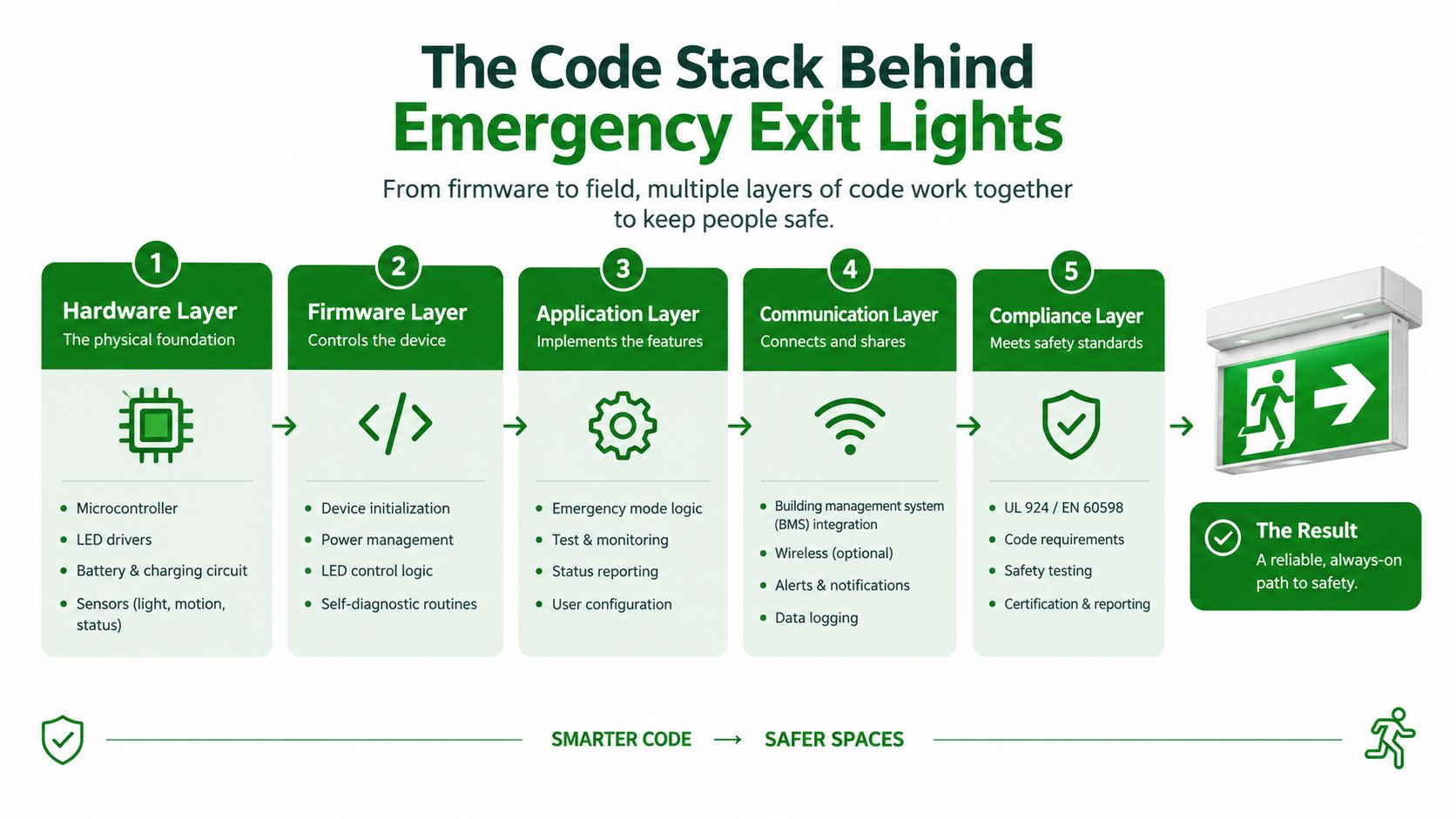
Most confusion around emergency exit lights comes from the fact that no single book covers everything. Real compliance sits on top of a code stack. If you manage office, retail, multifamily, hospitality, or industrial property in Southern California, you're dealing with overlapping rules that each answer a different question.
The baseline layers
Start with the performance backbone. NFPA 101 Life Safety Code is where many teams look for the practical life-safety expectation: exit routes must remain usable during a loss of normal power, and emergency illumination has to support evacuation long enough to matter.
Then there's OSHA, which matters any time the property is a workplace. OSHA requires exit routes to be adequately lighted and exits clearly marked, and it recognizes compliance with NFPA 101 (2009 edition) or the 2009 International Fire Code as satisfying those workplace exit-route provisions in 29 CFR 1910.34, 1910.36, and 1910.37 according to this summary of OSHA and code-law alignment.
The International Building Code and International Fire Code shape what gets installed in new construction, remodels, and tenant improvements. The National Electrical Code handles wiring methods, circuiting, identification, and how the electrical side gets built in a way that can survive real use.
For a practical walkthrough of how these pieces show up in the field, this guide to emergency lighting code requirements is useful if you're comparing plan intent to actual site conditions.
What a non-engineer should pull from that stack
Here's the plain-English version property teams can act on:
- NFPA 101 tells you the life-safety outcome the building has to deliver.
- OSHA tells employers and workplace operators that exits must remain visible and usable.
- IBC and IFC influence where fixtures, signs, and path lighting are required in the built space.
- NEC governs how electricians wire the system so it can operate when normal power fails.
- California amendments and Title 24 add state-specific requirements on top of that base.
A plan set can say “code compliant” and still produce a bad inspection day if the field conditions don't match the paper.
Paper compliance versus inspection reality
Older buildings and tenant improvements get exposed. A fixture may be listed correctly, mounted correctly, and shown correctly on the original drawings. Years later, a corridor shifts, pallet racking rises, a partition gets added, or a sign is blocked by a storefront change. On paper, the system still exists. In practice, the egress route no longer works the way the original design assumed.
That gap is why experienced inspectors don't just look for equipment. They look for performance, visibility, coverage, and documentation.
Performance Benchmarks That Go Beyond a Button Test
A quick press of the test button tells you one thing. The unit woke up. It doesn't tell you whether the building has usable egress lighting for the whole evacuation window, or whether the exit signs and fixtures still produce the light levels the route needs.
What actually gets measured
A core performance target in emergency lighting guidance is about 1 foot-candle along the egress path during the emergency period, with the system expected to remain adequately lit for the full required duration, as outlined in this NFPA 101 emergency lighting compliance discussion. That matters at the walking surface, not just at the fixture lens.
Exit signs have their own measurable standards. A widely used requirement is at least 5 foot-candles (54 lux) at the face of externally illuminated exit signs, with EXIT lettering at least 6 inches high and principal strokes at least 3/4 inch wide, as summarized in this codes and laws reference on exit-sign requirements.
Emergency Exit Light Performance Benchmarks
| Metric | Minimum Requirement | What Inspectors Check |
|---|---|---|
| Egress path illumination | About 1 foot-candle along the path | Whether the walking surface stays usable, especially at stairs, turns, and landings |
| Exit sign face illumination | 5 foot-candles (54 lux) at the sign face for externally illuminated signs | Whether the sign legend is clearly visible under emergency conditions |
| Exit lettering size | 6-inch letters with 3/4-inch principal strokes | Whether the sign itself meets basic visibility rules |
| Duration under emergency power | Must remain adequate for the full required emergency period | Whether light output and runtime hold up together, not separately |
Why the short test misses real failures
A monthly button test is good at catching an obvious dead battery, open lamp, or charger issue. It's weak at catching the failures that create trouble during an actual outage.
Common examples include:
- Battery fade: The unit starts strong and drops out before the required window ends.
- LED output loss: The fixture illuminates, but not brightly enough to support the path it was assigned to cover.
- Aiming drift: Remote heads get bumped during maintenance, stocking, or repainting.
- Layout mismatch: The fixture still works, but the corridor changed and the original light pattern no longer fits.
A unit that turns on is not the same thing as a unit that still performs.
Serious maintenance programs treat photometric verification and fault containment as part of life-safety maintenance. That's a different mindset from simple fixture inventory, and it's the one more property teams need to adopt.
Testing and Maintenance Workflows That Pass Inspection
A fire alarm goes off at 6:10 a.m. A manager opens the stair door for the fire department, and one remote head over the landing is dark. The exit sign is still lit, so on paper the building can look fine. In the field, that is the kind of miss that turns into an AHJ write-up, a tenant complaint, or both.
The properties that stay out of that cycle use a repeatable testing workflow with records that tie each result to a specific fixture, circuit, and corrective action. Around Southern California, that matters because inspections rarely happen under ideal conditions. They happen after remodels, during tenant turnover, after nuisance outages, or when someone notices a dark path and calls it in.
The working test cycle
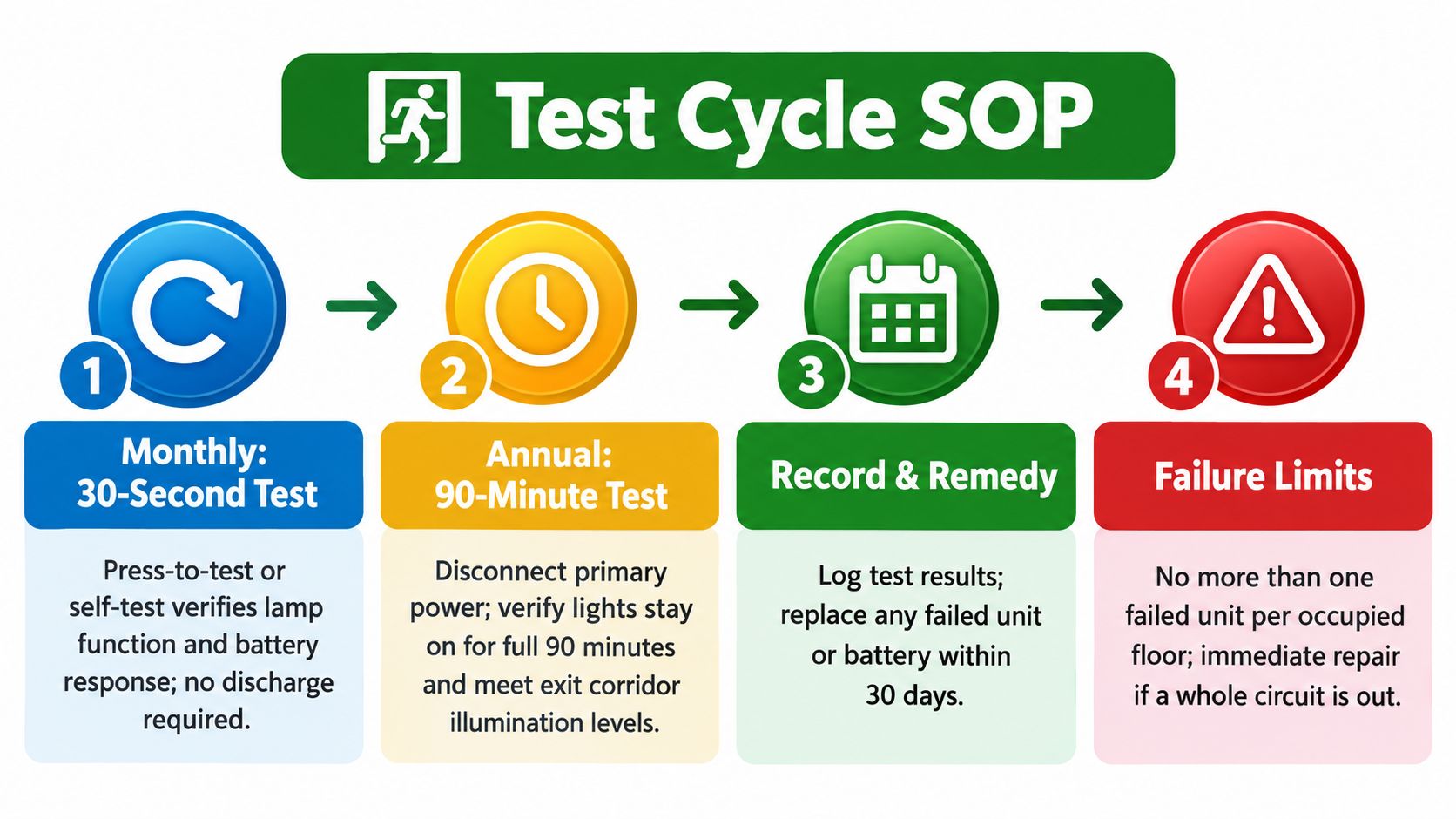
Battery-backed emergency lights and exit signs are commonly tested with a monthly functional test and an annual full-duration test, as summarized in the battery-powered emergency light testing standard summary.
Both tests matter, but they answer different questions.
The monthly check confirms transfer to emergency power, lamp operation, charger status, and obvious fixture failure. The annual discharge test answers the question inspectors and owners both care about. Will the unit still carry the load long enough to support egress after the easy failures have been ruled out?
That distinction gets missed all the time. A unit can light up on a button test and still fail before the required emergency period ends. On occupied sites, I also see fixtures pass their own self-diagnostic indicator while a remote head has been knocked out of aim, painted over, disconnected, or left covering a path that changed during a tenant improvement.
For teams building a service routine, this emergency lighting testing workflow for commercial properties reflects the level of documentation and follow-through that usually holds up best in the field.
What the log should contain
Logs need to do more than prove someone pushed a button. They need to show what was tested, how it was tested, what failed, and whether the repair was closed.
A usable log packet should include:
- Fixture ID and exact location, including stair, corridor, suite, room, or exterior egress area
- Fixture type, such as combo unit, exit sign, remote head, inverter-fed fixture, or unit equipment
- Test method, including local test button, circuit interruption, transfer test, or self-diagnostic review
- Date and person performing the test
- Observed condition, including lamp output, indicator status, physical damage, and aiming condition
- Annual runtime result or clear note that the fixture failed before the required duration
- Corrective action taken, such as battery replacement, charger replacement, re-aiming, lens cleaning, circuit repair, or full fixture replacement
- Retest date and final status after repairs
That last item saves a lot of trouble. Open deficiencies are where inspection packets fall apart.
Common failures that matter in the field
The failures that cause inspection problems are usually ordinary service issues, not exotic defects.
A stair fixture with a weak battery may still strike bright for the first few minutes, then fade hard near the end of the discharge cycle. Remote heads in stock rooms and service corridors get bumped by carts and ladders. Exit signs survive for years while the emergency heads tied to the same path are half buried by paint, dust, or a remodel that changed the wall layout. In older properties, a breaker relabel or panel change can also leave test procedures inconsistent from one building engineer to the next.
Fault containment matters here. If one unit fails, the path should not go dark because the layout depended on a single fixture doing too much work. That is where the newer performance mindset helps. Instead of treating emergency lighting as a box-checking exercise, property teams should review whether each tested fixture still supports the route it was assigned to cover after tenant improvements, rack changes, door swaps, and partition work.
In California, clean records and closed corrective actions carry real weight. If an inspector asks for the log, a packet with fixture IDs, test dates, failures noted clearly, and repairs already retested will usually go a lot smoother than a binder full of checkmarks with no detail.
Battery Backup Options and Total Cost of Ownership
Battery chemistry affects more than replacement cost. It changes service frequency, nuisance-failure risk, labor planning, and how often someone has to roll a truck because a fixture looked fine until the annual test exposed it.
The chemistry decision most retrofits face
Most commercial retrofits end up choosing between sealed lead-acid, nickel-cadmium, and lithium-based battery platforms. Each has a place. The wrong choice usually shows up later as maintenance drag.
Sealed lead-acid often wins the budget conversation up front because the unit cost is lower. The downside is the maintenance burden. In warmer electrical rooms, parking structures, and buildings with frequent nuisance outages, these batteries usually become a recurring replacement item sooner than owners expect.
Nickel-cadmium handles tougher temperature swings better and has a long history in exit signage and unit equipment. The trade-off is disposal handling and replacement planning, especially in California where waste streams and documentation get more scrutiny.
Lithium platforms reduce routine battery swap frequency and pair well with self-diagnostic equipment. The objection is almost always first cost, not field performance.
Emergency Exit Light Battery Chemistry Comparison
| Chemistry | Typical Lifespan | Upfront Cost | Maintenance Cycle | Temperature Tolerance | Disposal Notes |
|---|---|---|---|---|---|
| Sealed lead-acid | Shorter in real-world retrofit service | Lower | More frequent battery replacement and retesting | Less forgiving in harsh conditions | Requires proper recycling stream |
| Nickel-cadmium | Moderate to long depending on environment | Mid-range | Steady maintenance, but often better resilience than SLA | Generally better with temperature swings | Disposal deserves close attention in California |
| Lithium iron phosphate | Longer service interval in many commercial applications | Higher | Fewer battery changeouts, strong fit for self-test fixtures | Generally stable for commercial use | Follow manufacturer and local disposal guidance |
What usually works better over time
Property managers rarely ask for chemistry in abstract terms. They ask practical questions:
- How often will this create a service call?
- Will the battery hold up in a hot back-of-house area?
- Does the fixture report its own trouble condition clearly?
- Is the building team going to be replacing batteries constantly?
A lot of owners find that a higher first-cost platform pencils out once labor, reinspection risk, and repeat dispatches are considered. This is especially true when paired with modern self-diagnostic units and documented maintenance. For teams comparing equipment options, battery backup exit light configurations are usually best evaluated as a lifecycle decision, not a shelf-price decision.
California Title 24 and Emergency Lighting Compliance
California adds another layer that catches out-of-state owners and even some local teams off guard. Title 24 is not the same thing as life-safety code, but it absolutely affects emergency lighting projects, especially when you touch controls, replace fixtures as part of a larger lighting scope, or go through occupancy and acceptance steps.
Where Title 24 enters the conversation
NFPA and OSHA deal with safe egress. Title 24 Part 6 deals with energy code requirements, control behavior, and acceptance documentation. Those worlds overlap in the field because many modern emergency lighting products include self-diagnostic features, control interfaces, and listing language that show up during plan review and final sign-off.
That means a building can have functioning emergency exit lights and still hit problems if the installed system doesn't match the control documentation, acceptance forms, or listed operational sequence required for the project scope.
What property teams usually miss
The common miss isn't the fixture. It's the paperwork and the trigger point.
Watch for these situations:
- Major lighting retrofits: Control changes can pull emergency lighting components into broader Title 24 review.
- Tenant improvements: Revised space layouts may require updated emergency lighting placement and matching documentation.
- Occupancy turnover: Acceptance records often become important right when the new user needs final approvals fast.
- Self-diagnostic equipment: Reporting features and control behavior need to align with what the approved submittal and acceptance path expect.
CALGreen can also intersect with broader project documentation, but it doesn't replace life-safety testing or Title 24 acceptance obligations. Those are parallel responsibilities, not substitutes.
The field reality in Southern California
The practical issue is simple. Passing your routine emergency-light test log doesn't automatically clear the project from a California compliance standpoint. If acceptance records are incomplete, certificates aren't filed correctly, or the installed controls don't match the approved sequence, the job can stall.
That's why experienced contractors and property teams treat life-safety records and Title 24 closeout as connected but separate deliverables. One proves the system operates. The other proves the project was documented and accepted the way California requires.
Designing for Real Faults, Not Just a Power Outage
A lot of emergency lighting layouts are built around one event. Utility power drops, the battery comes on, people exit. That's the baseline. It's not the whole risk picture.
Real failures are messier. A breaker trips in one panel. A driver fails in a run of fixtures. A mixed-generation retrofit leaves one corridor dependent on too few units. The batteries are technically alive, but the path still goes dark in the wrong place.
The shift toward fault containment
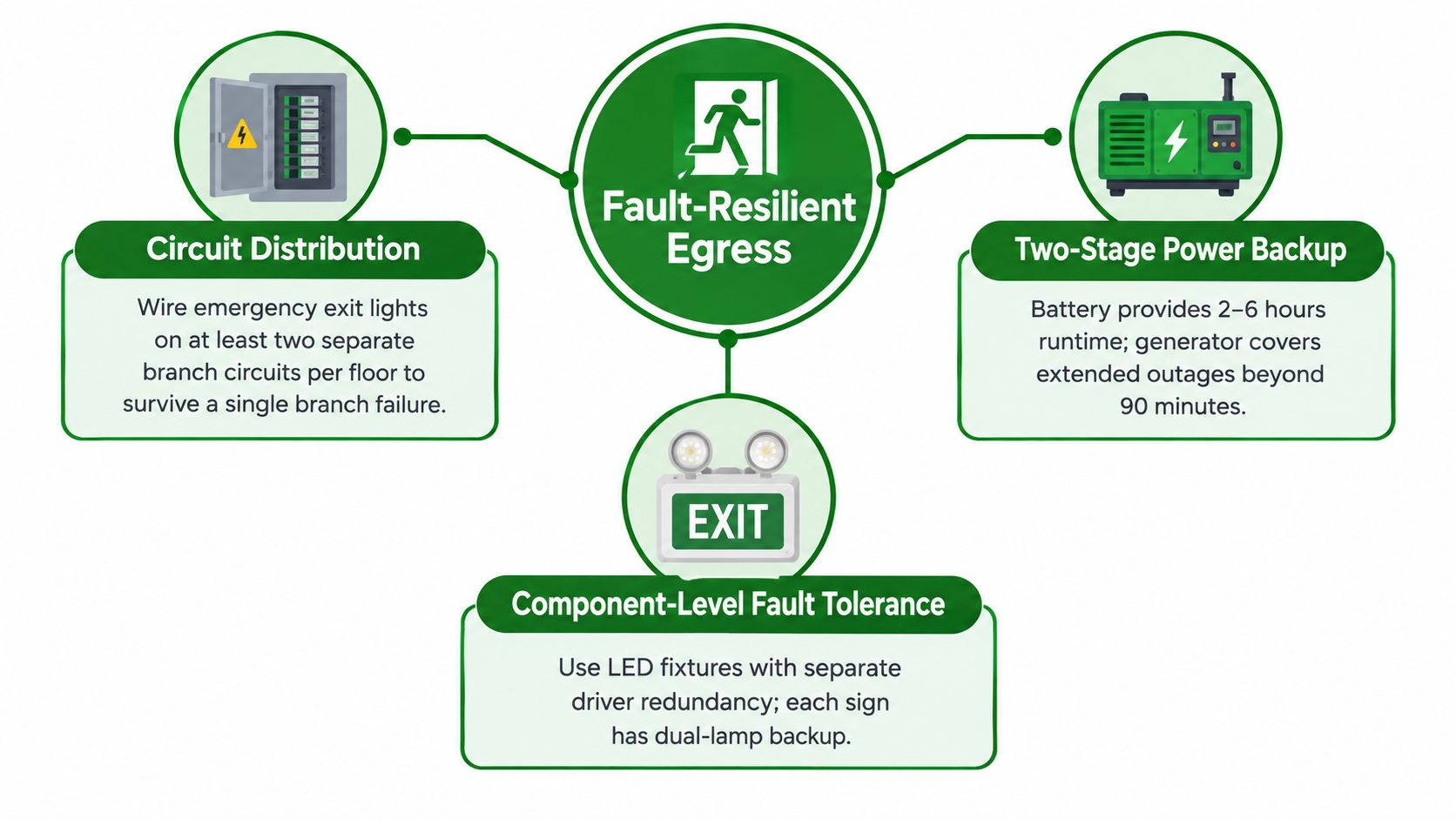
Newer thinking is useful, even for U.S. properties that still operate under older habits. Guidance tied to BS 5266-1:2025 says high-risk areas should be wired from at least two separate circuits, with no more than 20 luminaires affected by a single circuit fault, reflecting a stronger focus on fault containment in real failures according to this summary of BS 5266-1:2025 changes.
That's worth paying attention to because it addresses a common blind spot in commercial buildings. One failure shouldn't wipe out too much of the route of egress at once.
What that means in practice
Better field design usually includes some mix of these moves:
- Circuit separation: Don't cluster too much path coverage on one branch circuit.
- Redundant coverage at turns: Corridor bends and stair doors are bad places to rely on a single head.
- Smarter sign spacing: Offset hallways and obstructed sightlines often need more deliberate sign placement.
- Generator and battery coordination: In larger properties, separate the short-term battery function from the longer outage strategy.
- Post-renovation light checks: After a tenant improvement or LED conversion, confirm the route still performs in the actual built condition.
The hidden failure isn't always total darkness. It's partial visibility loss in exactly the spot where occupants hesitate.
Why photometric re-verification matters after changes
One of the most overlooked issues in retrofit work is assuming equal wattage means equal result. It doesn't. Beam shape, lens pattern, mounting height, and corridor geometry all matter. An LED conversion can reduce maintenance and still create a weak spot if the new light distribution doesn't match the old fixture's emergency role.
That's why serious property teams don't stop at a passing sticker. They revisit coverage after build-outs, merchandising changes, rack adjustments, and corridor reconfigurations. The more active the property, the more important that habit becomes.
Why a Documented Service Program Pays for Itself
Ad-hoc checks feel cheaper until the first time someone asks for records, or the first time a whole floor has multiple failed units that nobody noticed because the last walk-through focused on occupied suites and not the back stair.
What the reviewer wants to see
When an AHJ, insurer, or ownership representative asks about emergency exit lights, they usually aren't looking for verbal reassurance. They want a trail.
A solid service record shows:
- Dated test results tied to specific fixtures or areas
- Who performed the work and whether that person had the right trade competency
- Battery replacement history instead of vague notes
- Corrective-action tickets that show deficiencies were closed
- Consistency from month to month rather than gaps and catch-up entries
That kind of packet is hard to produce from memory. It's easy to produce from a managed program.
In-House vs. Contractor-Managed Exit Light Programs
| Factor | In-House Ad-Hoc | Contractor-Managed |
|---|---|---|
| Test consistency | Depends on staff bandwidth and turnover | Scheduled cadence with documented completion |
| Record quality | Often uneven or incomplete | Typically fixture-based and inspection-ready |
| Failure follow-up | Can sit open until someone notices | Usually tied to a corrective service workflow |
| Trade troubleshooting | Limited if issue goes beyond a battery | Better for charger, circuit, and wiring faults |
| Inspection readiness | Reactive | More predictable |
| Budgeting | Irregular surprise spend | Easier to plan around recurring maintenance |
Why outsourced discipline often wins
For larger properties, the issue isn't whether in-house staff are capable. Many are. The issue is competing priorities. Site teams are handling tenants, leaks, access, vendors, turnovers, and after-hours incidents. Emergency lighting drifts down the list until an outage or inspection puts it back at the top.
That's where a contractor-managed program earns its keep. A licensed C-10 electrical contractor can test, document, repair, and flag system-level problems that a visual check won't catch. Access Electrical and Lighting provides that kind of commercial support for Southern California properties, including installation, testing, maintenance, and repair of emergency lighting and exit sign systems.
The payoff is usually operational, not theoretical. Fewer surprise failures. Fewer missing logs. Fewer rushed calls right before a fire inspection. More predictable battery replacement planning. Less argument over what was checked and when.
If the building ever has an injury claim tied to an unlit path of egress, the absence of records becomes its own problem. Clean documentation won't solve a bad system, but a bad system with no documentation is much harder to defend.
If your property team is dealing with aging exit signs, failed battery units, annual test logs, or a Title 24 closeout that doesn't line up with the field conditions, Access Electrical and Lighting handles commercial emergency lighting installation, testing, maintenance, and repair across Southern California. They can help you sort out what needs repair, what needs documentation, and what only looks compliant until the next outage or inspection.