You usually don't start by saying, “I need an electrical panel upgrade in San Diego.” You start with symptoms. A tenant improvement stalls because the new equipment load won't pencil out. Breakers trip when HVAC and common-area loads overlap. An EV charging request looks simple until someone checks the service. A panel that has worked for years suddenly becomes the bottleneck for the whole property.
That's why this job gets misunderstood. Owners often treat it like a box swap. In practice, an electrical panel upgrade in San Diego is a load-capacity decision tied to permits, plan review, and utility coordination. The labor to replace equipment may be straightforward. Keeping a building operational while the city, the utility, and the project scope all line up is the harder part.
Why San Diego Properties Outgrow Their Electrical Panels
A common San Diego scenario starts with a simple scope. A tenant improvement needs a few new circuits. A resident wants EV charging. An HVAC replacement shifts from gas to electric. Then the load review starts, and the panel becomes the limiting factor for the whole property.
That happens because many buildings were designed around older demand patterns. The original service may have handled lighting, standard receptacle loads, and smaller mechanical equipment without much trouble. Add heat pumps, house loads, commercial kitchen equipment, gate motors, elevators, EV chargers, or ADUs, and the margin disappears fast. The panel is rarely the whole story. Service capacity, distribution, and breaker coordination usually drive the decision.
The common property-manager scenario
On site, the warning sign is often operational rather than dramatic. The building stays online, but every new project starts running into electrical questions. A small remodel triggers a load calculation. A new tenant asks for equipment with higher nameplate demand. The panel schedule looks full, the existing gear is aging, and nobody wants to promise a completion date until the service is checked.
That is why I do not treat these jobs as box swaps. On multifamily and commercial properties, the question is whether the existing service can carry present load, added load, and foreseeable future load without creating coordination problems upstream or inspection problems later. A panel with open breaker spaces can still be the wrong panel if the service, fault rating, or distribution layout no longer fits the building.
Why 200 amps is only the starting point
In San Diego County, the building standards ordinance sets a clear floor. The main electrical service panel shall have a minimum rating of 200 amps in that jurisdiction, and EV charging review can trigger formal load calculations under California Electrical Code Article 220 when an existing panel is below that threshold. The county service table also lays out the service sizing thresholds in detail. You can review that directly in the San Diego County building standards ordinance.
For owners and managers, the practical point is straightforward. A 200-amp label does not answer whether the property is set up correctly for the next project. Capacity has to be verified against actual connected load, demand assumptions, and the way the building is distributed. In many upgrades, selective coordination, available fault current, meter section limits, and utility requirements matter as much as the amp rating on the main.
Timeline and cost usually follow that same reality. Labor to replace gear is often the shorter part. Utility planning, meter spot issues, plan review comments, shutdown scheduling, and equipment lead times are what stretch the job in San Diego.
What usually causes the problem
A few patterns come up over and over:
- Incremental electrification: Heat pumps, EV charging, and electric water heating add demand the original service was never built around.
- Tenant turnover: New uses often carry different load profiles than the prior occupant, especially in retail, office, and mixed-use space.
- Old distribution assumptions: A service that worked for years may still fail a new load calc once common-area equipment and future capacity are counted correctly.
- Workarounds layered over time: Added subpanels, uneven circuit loading, and years of small modifications can leave a property operational but boxed in.
The better approach is early verification by a licensed C-10 contractor. Review the service size, calculated load, existing gear condition, available space, and utility path before the project schedule gets committed. That is how property managers avoid finding out in plan check that the job is bigger than the original scope.
Signs You Need an Upgrade and How to Confirm Them
A property usually shows panel trouble in operations before it shows up on a one-line diagram. The call often starts the same way. A breaker trips during normal use, lights dip when rooftop units start, or a new tenant improvement stalls because nobody can confirm spare capacity. At that point, the question is rarely just whether the main is “big enough.” The issue is whether the existing service, distribution, and protection scheme still support the building you have now.
Some signs are visible before anyone removes a dead front. Repeated nuisance tripping under ordinary loading is one. Flicker during motor starting is another, especially when it affects more than one area. Maintenance workarounds also tell a story. If staff are shifting circuits around, avoiding simultaneous equipment use, or feeding added loads through whatever space was available, the building is already operating around a limitation.
Physical condition matters too.
- Heat or discoloration: Scorch marks, browned insulation, or a warm panel cover point to overloaded conductors, loose terminations, failing breakers, or bus damage.
- Crowded modifications: Tandem breakers where they do not belong, multiple generations of add-ons, or poorly labeled subfeeds usually mean the original distribution was stretched over time.
- Equipment that no longer matches the use: A panel that served the prior tenant may not support current HVAC, kitchen, EV, or office loads even if it has not failed yet.
- Permit friction during other projects: If a remodel, service equipment change, or EV install triggers questions about capacity or fault duty, treat that as a field warning, not just paperwork.
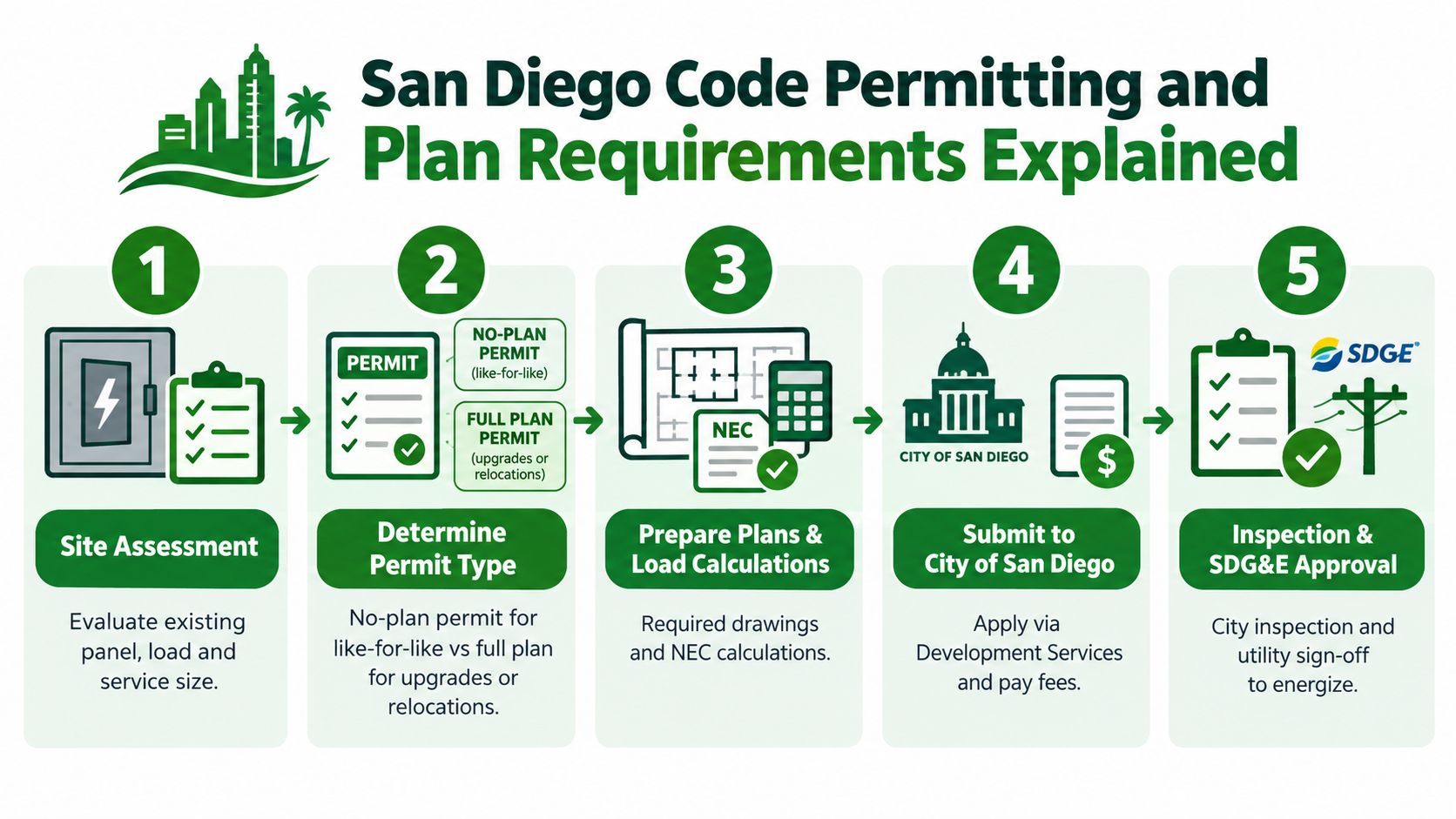
Here's the permit and planning flow many owners don't see until they're already behind schedule:
Confirmation should happen in the field, not by guesswork or by matching the next project to a round-number panel size. Start with the existing gear. Verify the service rating, panel bus rating, breaker condition, conductor sizes, labeling, and how the loads are distributed. Then compare that to the loads being added and the way the building operates during peak use. As noted earlier, local requirements can trigger a formal load review, but the practical question is broader: can the service handle the added demand and still coordinate properly during a fault or shutdown event?
Infrared scanning helps here. It will not replace calculations, but it can quickly show overheated lugs, imbalance between phases, stressed breaker terminations, and bus connections that need immediate attention. For occupied commercial and multifamily properties, that matters because it helps separate a capacity problem from a maintenance failure. Those are different scopes, different costs, and sometimes different permit paths.
Use a short field checklist before asking for pricing:
- Record the actual service equipment data. Main breaker, bus rating, meter stack information, and any labels showing replacement restrictions.
- List new and recent loads. EV chargers, HVAC conversions, electric water heating, tenant equipment, common-area improvements, and house loads.
- Document operating symptoms. Note what was running when trips, flicker, or overheating showed up.
- Check distribution, not just total load. One overloaded section or poorly placed subfeed can create problems even when the service is not fully maxed out.
- Scan for heat and termination issues. An infrared inspection often finds trouble that a visual check misses.
- Review the project in context. If the panel issue shows up during a tenant improvement or electrification project, confirm whether the service, feeders, and coordination study all need to move together.
A panel that still turns on the building can still be the wrong panel for the next project.
That is why owners get better results when they verify symptoms early with a licensed C-10 contractor. The cleanest jobs start with field confirmation, load review, and an honest look at the existing distribution. In San Diego, that usually saves more time than rushing to order replacement gear, because utility coordination and permit review tend to drive the schedule long before the crew starts the shutdown.
San Diego Code Permitting and Plan Requirements Explained
The City of San Diego doesn't treat panel upgrades as casual electrical work. Whether the project moves smoothly or stalls usually comes down to whether the permit path was set up correctly from the beginning.
Start with the permit type, not the replacement date
For San Diego panel upgrades, the city requires electrical plans and calculations for work that doesn't qualify for a simple no-plan permit, and panel-upgrade plans must be signed and stamped by a California registered electrical engineer or C-10 contractor. The city's permitting guidance also states that circuit breakers up to 400 amps can fall under its electrical permitting framework, while breakers exceeding 400 amps require a stand-alone electrical permit with building plans. Those requirements are laid out in the City of San Diego electrical permit guidance.
That one point changes how owners should budget and schedule the job. If the upgrade triggers plan review, you're not booking an electrician and a shutdown window. You're entering a documented process with submittals, corrections if needed, inspection sequencing, and coordination with the broader project.
The sequence that works
Owners get better outcomes when they follow the actual order of operations:
- Assess the existing service and load
- Prepare code-compliant plans and calculations if required
- Submit for permit
- Complete plan review
- Schedule field work and inspection
If you skip the first step, the rest of the file often gets rebuilt later. That's especially common when a panel scope is bundled into a broader remodel package without clearly separating electrical requirements.
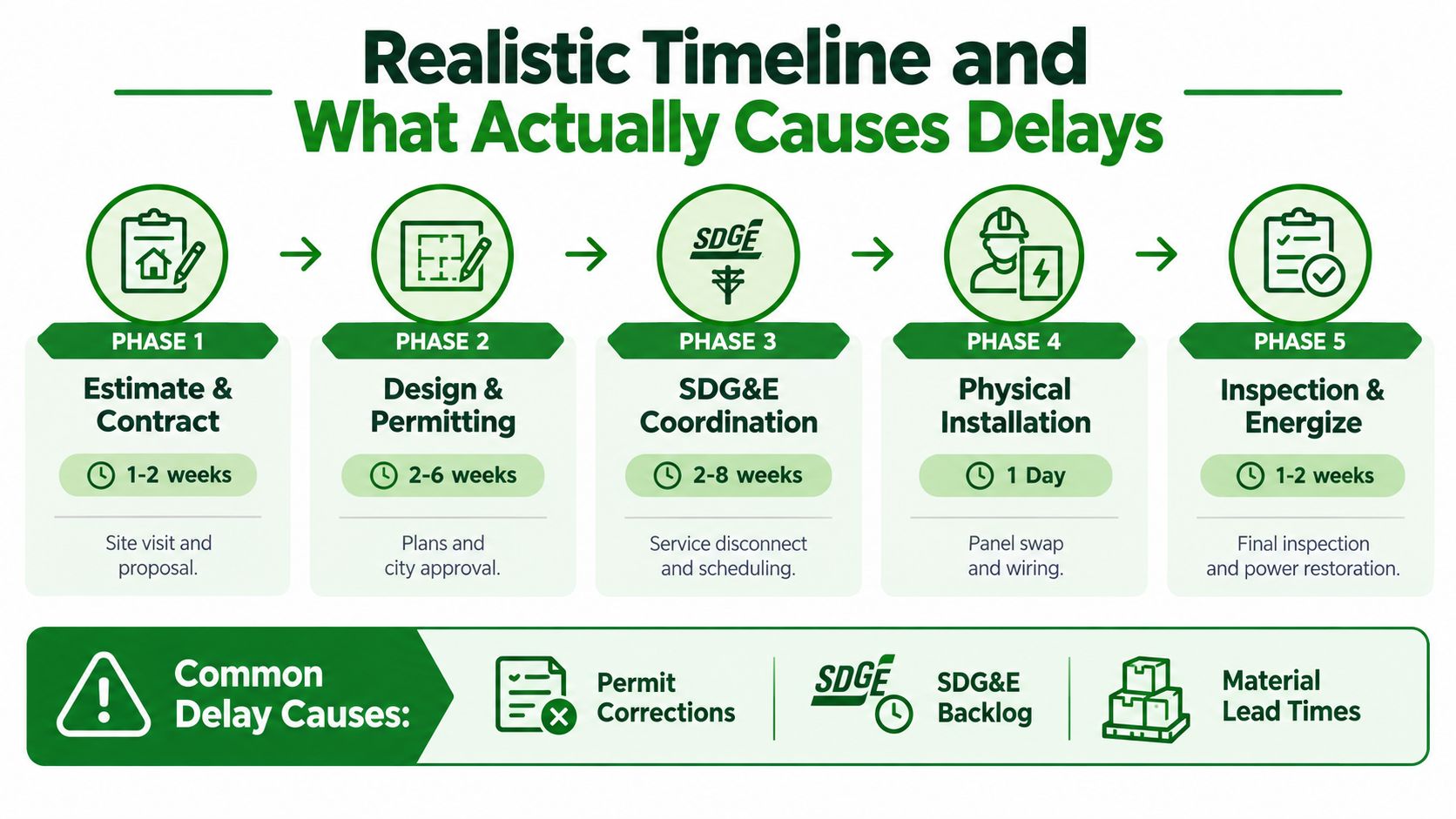
This timeline visual matches what happens in the field more than the “one-day upgrade” sales version:
Who can pull the permit and where jobs get stuck
San Diego rules are strict about applicant eligibility and submittal quality. Separate electrical permits are often a critical issue on commercial and multifamily work, particularly where owners assume the building permit covers all electrical scope. It often doesn't.
Common failure points include:
- Missing calculations: The city can delay or reject submittals that lack the load study needed to justify the new service.
- Wrong permit structure: Mixed-scope jobs involving PV, EV charging, or tenant improvements often need tighter coordination than applicants expect.
- Licensing mismatches: Permit issuance is restricted to licensed contractors or qualifying owners or lessees under local rules, as summarized in San Diego permit guidance discussed further below.
- Poor cross-trade coordination: Meter relocation, structural backing, and service equipment placement can affect more than one review discipline.
For owners managing occupied buildings, a contractor with compliance experience helps. If you need a broader review of inspection readiness and code documentation, electrical code compliance for commercial properties is part of the same conversation as the panel itself.
Field advice: The panel is only one line item. The permit package has to make sense as a whole, or the city treats the application like an incomplete project.
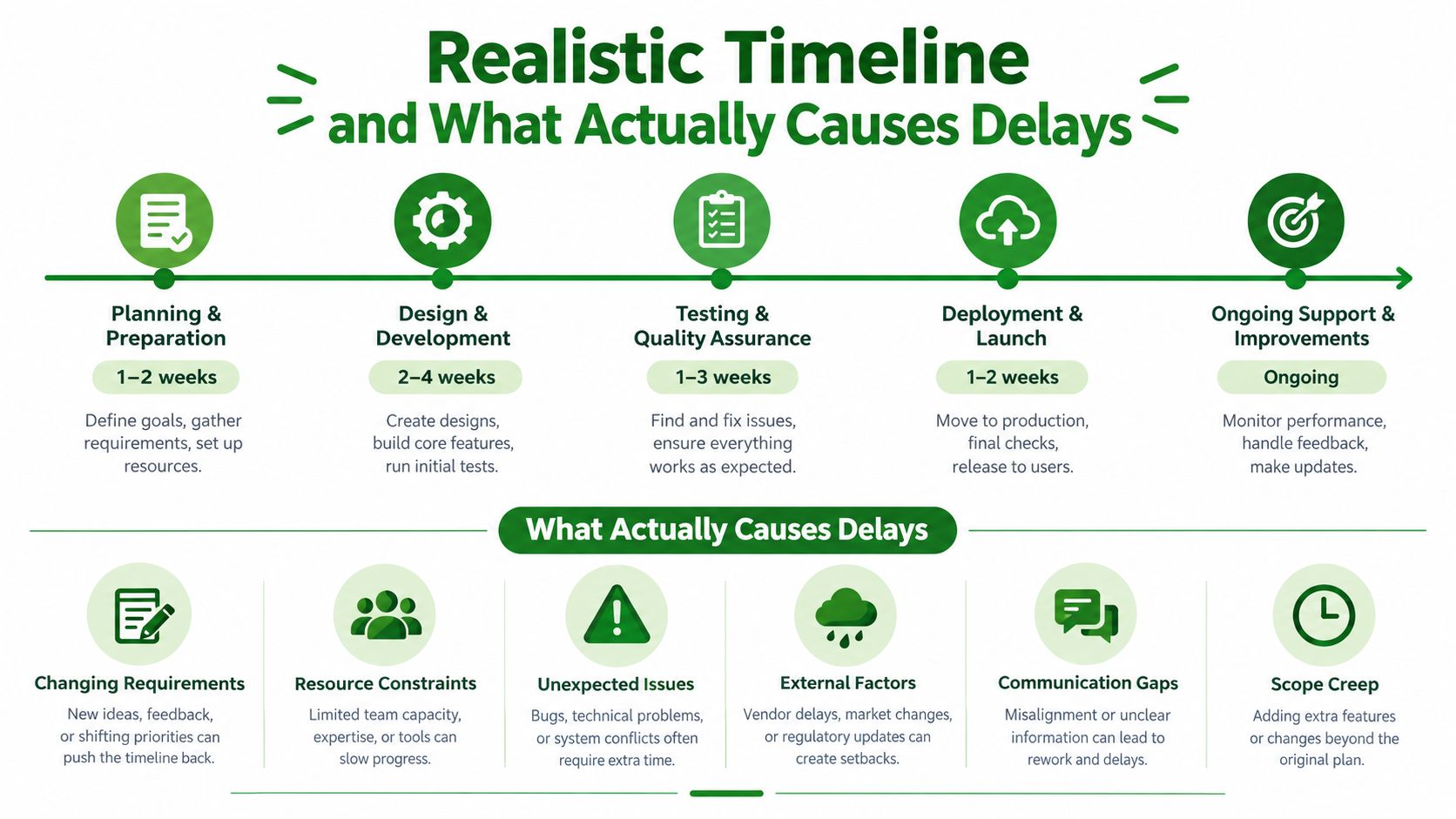
Realistic Timeline and What Actually Causes Delays
The physical panel swap can be quick. The project usually isn't. That difference is where most schedule promises go wrong.
The one-day install is only one phase
Local service pages often advertise the install itself as a one-day event, and that can be true for the field labor. But neutral local guidance also notes that a typical San Diego upgrade may require a city permit, SDG&E service-change scheduling, trench or meter-location requirements, and final inspection before power is restored. That broader coordination issue is outlined in this San Diego panel upgrade overview.
Owners should plan around the full chain, not the crew-hours on site. The electrician may only need a short outage window to perform the replacement. The city and utility schedule can still stretch the project well beyond that.
San Diego timing rules that affect operations
San Diego's permit rules create timing pressure before anyone turns a screw. Local guidance states that a separate electrical permit must be obtained before work begins, and if emergency work starts first, the permit must be obtained within 24 hours, excluding weekends and holidays. The same guidance notes that separate permits are required for each stand-alone structure and that electrical and MEP permits are separate from building permits for non-residential and multifamily construction. Those practical points are summarized in this San Diego electrical permit rule overview.
For property managers, that means the common shortcuts don't hold up well:
- “We'll start now and clean up permits later.” That's risky unless the situation qualifies as emergency work and the follow-up is immediate.
- “It's all one property, so it's one permit.” Not necessarily, especially with stand-alone structures.
- “The building permit should cover it.” Often false on commercial and multifamily jobs.
What actually stretches the schedule
Delays usually come from coordination failures, not wrench time.
Utility scheduling and permit corrections usually drive the calendar more than the panel replacement itself.
A few examples show up repeatedly:
- Load study comes in late: The project gets priced before the service size is confirmed.
- Submittal corrections: Drawings, calculations, or scope descriptions don't match what the city expects.
- Utility dependencies: Meter work, disconnect scheduling, or service changes don't line up with the install date.
- Mixed-scope remodels: EV, PV, HVAC, and tenant improvements all affect the same service capacity question.
- Access and occupancy constraints: In multifamily and commercial settings, shutdown planning can be harder than the installation.
This is the practical timeline most owners should expect: assessment first, permit path second, utility coordination third, field work fourth, final inspection last. If any one of those pieces starts late, the project rarely catches up by itself.
Here's a simplified view of the schedule pressures owners feel:
Cost Ranges and Choosing the Right Upgrade Option
Price becomes clearer once you stop treating the project as “replace the panel” and start treating it as “solve the load and service problem with the least disruption that still passes.”
What San Diego owners should budget for
Recent San Diego market content shows broad price bands of roughly $2,800 to $8,500 for common residential upgrades, with larger 200A-to-400A or service-combination projects costing more, according to this San Diego panel upgrade cost guide. Even if your property is commercial or multifamily, that spread is useful because it shows how quickly scope changes can move the number.
Permit costs should also be part of the early budget. The City of San Diego fee schedule explicitly lists “Panel Replace/Upgrade up to 200 amp” at $176.57 per panel, and it separately lists “Circuits 50-200 Amps” at $353.13, which confirms that this work is its own permit category rather than informal maintenance. You can review those figures in the City of San Diego fee schedule information bulletin.
Why price spreads so much
Two jobs with the same target amperage can price very differently because the drivers are site conditions and project scope:
- Service configuration: A straightforward replacement is different from a broader service upgrade.
- Meter and utility work: If the service arrangement changes, the job usually gets more involved.
- Trenching or relocation: Civil and access issues add cost quickly.
- Bundled scopes: EV charging, solar readiness, or tenant-improvement electrical packages often change the design and permit path.
Owners looking for a deeper budgeting discussion can also review electrical panel upgrade cost considerations.
Panel Upgrade Options Compared for San Diego Properties
| Option | Typical Cost Range | Best For | Permit Complexity |
|---|---|---|---|
| Full panel replacement or service upgrade | Roughly $2,800 to $8,500 for common San Diego residential-style upgrades, with larger service-combination work costing more | Properties adding major new loads, dealing with obsolete equipment, or supporting broader electrification | Moderate to high |
| Subpanel addition | Qualitatively lower-impact when the main service still has capacity | Detached loads, localized distribution needs, tenant areas, garages, equipment zones | Moderate |
| Load management approach | Varies by equipment and control strategy | EV-driven projects where peak demand can be managed instead of enlarging service | Moderate |
| Targeted service change without full building-wide rework | Highly site-specific | Properties with a narrow capacity problem tied to one new load or area | Moderate to high |
How to choose the right scope
A full upgrade makes sense when the service is undersized for current and planned loads, or when the existing equipment has become a compliance obstacle. It's usually the right call for properties stacking multiple new electrical demands at once.
A subpanel can be smarter when the main service still has headroom and the need is better distribution. Load management can work when the pressure comes from EV charging rather than whole-building electrification. A targeted service change may also make sense if one area of the property is the driver.
The wrong move is paying for a full upgrade because it sounds safer when the load calculation doesn't require it. The second wrong move is trying to avoid a service upgrade when the numbers and permit path clearly point there.
How to Hire a Licensed C-10 Contractor and Plan Your Next Steps
A panel upgrade affects uptime, inspections, tenant coordination, and future capacity. That's why the contractor choice matters as much as the equipment choice.
What to verify before you ask for a bid
Start with the basics, but don't stop there. A California C-10 contractor should be properly licensed and bonded. For commercial and multifamily work, you also want someone who understands service equipment, tenant-improvement coordination, shutdown planning, and the paperwork side of code compliance.
Strong screening questions include:
- Have they handled occupied properties before? A vacant building and an operating multifamily site are different jobs.
- Can they perform or coordinate load calculations? If not, they're not leading the decision.
- Do they use infrared diagnostics when conditions call for it? Thermal issues often tell you more than a visual glance.
- Can they manage related scopes? High-reach work, Title 24 documentation, EV infrastructure, and low-voltage coordination may all touch the same project.
- Do they offer after-hours response if the shutdown goes sideways? That matters more than a polished estimate.
What a useful pre-bid package looks like
Give bidders enough information to price the job. At minimum, assemble:
- Existing service information and any prior panel labeling.
- A list of added or planned loads tied to the project.
- Site access limits such as tenant notice windows or utility-room restrictions.
- Any correction notices or failed inspection comments already received.
- Photos of the panel, meter location, and surrounding conditions if available.
That lets contractors identify whether they're pricing a replacement, a service upgrade, a relocation issue, or a larger coordination problem.
One-contractor versus multi-contractor coordination
Commercial owners often save headaches when one contractor can manage both line-voltage and related low-voltage or controls issues under the same roof. For example, commercial electrical contractor services may include panel work, electrical troubleshooting, infrared inspections, EV infrastructure support, lighting controls, and tenant-improvement coordination. Access Electrical and Lighting is one contractor operating in that space across Orange County, the Inland Empire, and San Diego.
That kind of fit matters when the panel upgrade is really attached to a broader building problem, not a standalone box replacement.

Ask every bidder the same direct question: “What part of this schedule depends on the city, what part depends on the utility, and what part depends on your crew?” If they can't separate those clearly, the timeline probably isn't real.
The best next step is usually not “replace the panel.” It's “schedule a site assessment and load review, then decide the permit path from there.” That keeps the project grounded in capacity, compliance, and building operations instead of guesswork.
Access Electrical and Lighting handles commercial and multifamily electrical upgrades, troubleshooting, infrared inspections, lighting systems, and related infrastructure work across Southern California. If your property is running into capacity limits, permit friction, or shutdown-planning issues, visit Access Electrical and Lighting to line up an assessment, load study, and the right upgrade scope before the project stalls.