You usually don't get called about emergency lighting when everything is working. You get called when a tenant notices a dark stairwell sign, when a fire marshal spots a dim unit during a walkthrough, or when a building owner is trying to get through an inspection before a lease signing and a dead fixture suddenly becomes everyone's problem. That's the life of emergency exit lights with battery backup, they're easy to ignore until the day they aren't.
For owners, the fixture itself is only half the issue. The other half is the maintenance discipline that keeps the system ready, documented, and defensible when an AHJ asks for records. In the field, that's where most buildings either stay ahead of trouble or get caught trying to explain why a battery test was skipped and a logbook is missing.
Why Battery-Backed Exit Lights Matter in Commercial Buildings
A hallway sign can look fine at noon and still be weak after hours. An exit unit by a stair door can chirp for weeks before anyone schedules service. Those failures usually show up at the worst time, during a tenant move-in, a lease close, or a routine inspection that turns into a correction notice.
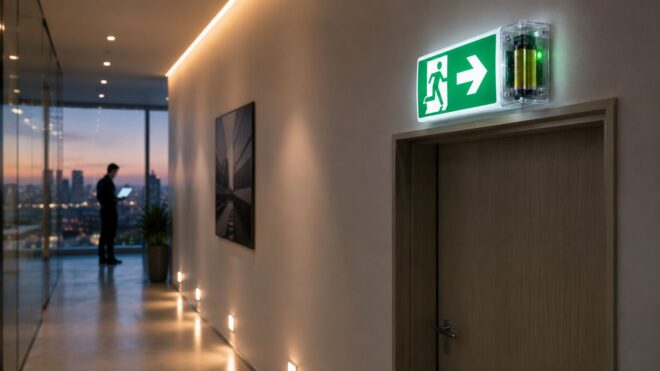
Emergency exit lights with battery backup keep egress paths visible when normal power drops. They are part of the life-safety system, not decorative lighting, because people still need to find doors, stairs, and corridors during a fire or outage. NFPA 101 ties that duty to a 30-second monthly functional test, a 90-minute annual battery-duration test, and record retention rules in some jurisdictions that adopt those requirements, with the 90-minute benchmark serving as the endurance target for prolonged power loss (Healthcare Facilities Today summary of NFPA 101 battery-powered exit sign testing).
What property teams usually miss
Many buildings still treat these fixtures like a construction closeout item. That approach breaks down fast once an inspection fails or a battery can no longer carry load long enough to matter. The 90-minute runtime expectation also appears in UL 924-based products and in NFPA guidance, and it is reinforced by maintenance practices in AS/NZS 2293.2:2019, which focuses on ongoing inspection and maintenance instead of one-time install-and-forget thinking (AS/NZS 2293.2:2019 product information).
The core issue is service discipline. Heat, age, and repeated partial discharge wear batteries down. A fixture that flashes on command can still fail under a true outage, and that is why a button press alone does not prove readiness. The inspection record matters as much as the lamp.
Practical rule: if a fixture has not been tested under real battery discharge, nobody really knows what it will do in a real outage.
Owners also need a simple reference point for staff and vendors. A plain-English guide to emergency exit signs helps explain what the fixture is supposed to do, but the bigger lesson is operational: keep a map, keep a schedule, and assign one person to own the next test.
The buildings that stay compliant treat emergency lighting as a living system. The ones that do not usually find the gap when the inspector already has a clipboard open.
How Emergency Exit Lights with Battery Backup Work
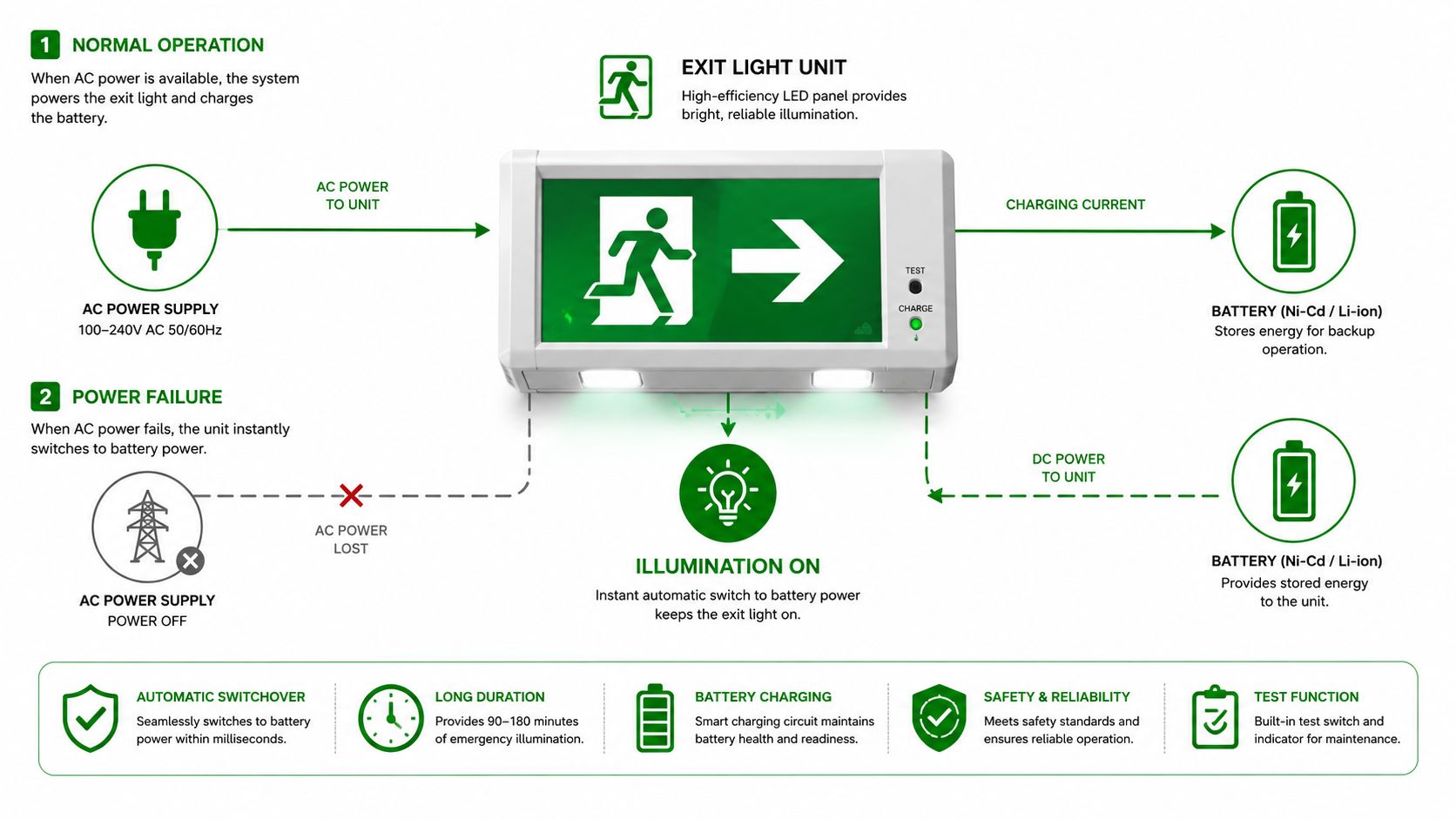
At the device level, the system is straightforward. A battery-backed unit includes a light source, a battery pack, charging and transfer circuitry, and a test switch or status indicator. Under normal power, the unit charges and stands ready. When power drops, the circuitry transfers the load to the battery and keeps the lamps on.
A fixture can look fine on the wall and still fail under outage conditions. If the charger is weak or the battery is tired, a quick button test may still pass even though the unit will not hold up in a real interruption.
The parts that matter in the field
The lamp source is usually LED now, though older units still exist. LEDs are easier on runtime than older lamp types, but output still depends on the driver, optics, spacing, and battery condition. The battery pack is where most lifecycle failures show up, especially when heat, age, or repeated partial discharge eats into capacity.
The transfer circuit matters just as much as the battery. If the charger does not keep the battery ready or the switchover does not trigger cleanly, the fixture can fail even with a decent battery installed. A wall-button check tells you less than a full discharge test.
Field note: the fixture can look bright and still underperform along the floor path. Egress illumination is about where the light lands, not just how impressive it looks at the lens.
Exit signs and egress lights aren't identical
An exit sign marks the way out. An egress light illuminates the route itself. In many commercial buildings, one fixture does both jobs, especially in corridor and stairwell applications. Other spaces use separate signs and corridor heads, which is common where path geometry or mounting constraints make a combo unit awkward.
Common housing styles include universal-mount thermoplastic units, edge-lit signs, and combo units with adjustable heads. The physical style matters because it affects mounting, service access, and whether the sign stays legible against glare, tall ceilings, or busy interior finishes.
Code and Title 24 Requirements You Need to Know
Owners get conflicting guidance on these fixtures because vendors, inspectors, and contractors do not always talk about the same part of the job. The practical rule is simple: battery-backed exit lights must stay lit long enough to guide people out, and they must keep the path visible at a usable level.
NFPA 101 sets the endurance expectation, and the field reality is that short checks do not prove much. The standard-based routine uses a 30-second monthly functional test and a 90-minute annual battery-duration test, with the annual result recorded and kept where the jurisdiction requires it. Emergency lighting performance also has a floor-level expectation. Guidance tied to NFPA calls for 1 foot-candle initially at the floor, no less than 0.6 foot-candle average at the end of 90 minutes, and at least 0.06 foot-candle at any point along the egress path (NFPA Journal on emergency lighting performance).
California layers on its own practical expectations
California adds another layer through Title 24, and that is where owners often get tripped up on both installation and paperwork. The code framework pushes teams toward properly listed fixtures that serve exits, corridors, stairs, and ramps under real site conditions. Local enforcement can be stricter than the minimums on paper, so the installation review should cover visibility, access for testing, and the way the unit performs in the space, not just how it looks in the box photo.
The short version below is what owners usually need on hand.
| Requirement | NFPA 101 | California Title 24 |
|---|---|---|
| Runtime expectation | 90 minutes for battery-backed emergency lighting and exit signs | Same endurance expectation in practice |
| Functional testing | 30-second monthly test | Testing and documentation are still expected during inspection and maintenance |
| Full-duration test | 90-minute annual discharge test | Performance should be verified under real operating conditions |
| Illumination at egress | Initial and end-of-test minimums are specified in NFPA-based guidance | Egress placement and illumination must satisfy local enforcement |
| Product listing | UL 924 is the core U.S. safety standard referenced by codes | Listed and labeled equipment is expected |
| Local inspection nuance | Keep records that match the fixture ID and location | Some AHJs want to see the Title 24 lighting requirements for the space applied to the installed layout, not just the fixture cut sheet |
The last point matters in the field. I have seen perfectly good units create inspection friction because the team could not tie the fixture to the location, the test record, and the installed layout in a way the AHJ could follow. A simple, consistent paper trail prevents a lot of back-and-forth.
Use listed equipment, mount it per the manufacturer's instructions, and make sure the testing method is visible on the unit. For a California-specific overview, this Title 24 lighting requirements resource helps frame how emergency lighting fits into the broader code picture.
Testing Schedules, Documentation, and AHJ Expectations
A lot of inspection trouble starts with the paperwork, not the fixture. I have walked properties where the lights worked fine on test day, but the building team could not show when they were tested, who checked them, or which unit was tied to which location. That is enough to slow down an AHJ review.
The monthly and annual rhythm
The field routine is simple: do the monthly 30-second functional test, then complete the annual 90-minute discharge test and record what happened for each fixture. The test itself is only part of the job. The issue is proving the building stayed on schedule all year, not just at inspection time.
A short push-button check can hide a weak battery. A unit may light for a quick test and still fall short under sustained load. That is why I tell owners to treat the annual discharge as the key proof point.
Best practice: if a fixture flickers, drops early, or comes back weak after discharge, replace the battery or the unit before the next inspection window.
What the AHJ usually wants to see
AHJs usually want a clean trail, not a verbal explanation. Keep a log that shows the fixture ID, location, test date, test duration, technician initials, and any battery or replacement notes. If the records are scattered across binders, spreadsheets, and handwritten tags, the walkthrough gets harder than it needs to be.
A simple logbook format helps. Use one line per fixture, keep the location naming consistent with the installed layout, and note exceptions in plain language. If a unit failed the last discharge test, write down what was done, not just that it was “repaired.” That kind of detail helps when an inspector asks why one head was replaced and the one beside it was left in service.
Self-testing and self-diagnostic units help reduce missed checks, but they do not replace review. Someone still has to confirm the status, correct the fault, and keep the record current. For a field-focused refresher on how these visits and records are handled, the emergency lighting testing guide is a useful reference.
| Test Type | Cadence | Duration | Pass Criteria | Documentation |
|---|---|---|---|---|
| Monthly functional test | Monthly | 30 seconds | Lamps and indicators operate normally | Date, fixture ID, tester initials |
| Annual discharge test | Annually | 90 minutes | Fixture stays illuminated for full duration | Date, fixture ID, duration, result, notes |
A practical log also shows pattern failures before they become inspection problems. If one fixture keeps coming up weak while the rest of the circuit holds, that points to a battery, charger, or wiring issue that needs attention. In occupied buildings, that is the kind of detail that saves time during the next AHJ visit.
Battery Lifespan, Fixture Lifecycle, and When to Replace
The battery pack is usually the first thing to age out, but the fixture body doesn't always age with it. In the field, I separate three decisions. Replace the battery, replace the head or driver, or replace the whole fixture.
What tends to wear out first
Battery chemistry drives a lot of the replacement rhythm. Sealed lead-acid packs are often treated as a shorter-cycle maintenance item, nickel-cadmium units usually last longer, and lithium iron phosphate options can stretch much farther, especially in cleaner electrical environments with less heat stress. The exact life still depends on ambient temperature, discharge depth, and how often the unit is forced to work.
The housing matters too. A corroded enclosure, brittle diffuser, or failed charger board can turn a simple battery swap into a time sink. If the manufacturer has discontinued the OEM parts, the service call quickly becomes a replacement recommendation instead of a repair.
Rule of thumb: if the unit is failing for more than one reason, stop treating it like a battery issue. That's often a lifecycle issue.
Field signals that a fixture is nearing the end
You don't need a meter to spot a lot of bad units. Dim emergency heads, intermittent self-test indicators, yellowed lenses, and inconsistent runtime on the annual discharge all point in the same direction. So do units that pass one month and fail the next without any change in use.
Retrofit decisions often come down to labor, not just hardware cost. If a property has many units spread across occupied common areas, self-testing LED replacements can reduce walking time and simplify records. That doesn't make every retrofit automatic, but it does make the cost of a cheap unit look different once the service burden is counted.
Installation and Servicing Best Practices by Property Type
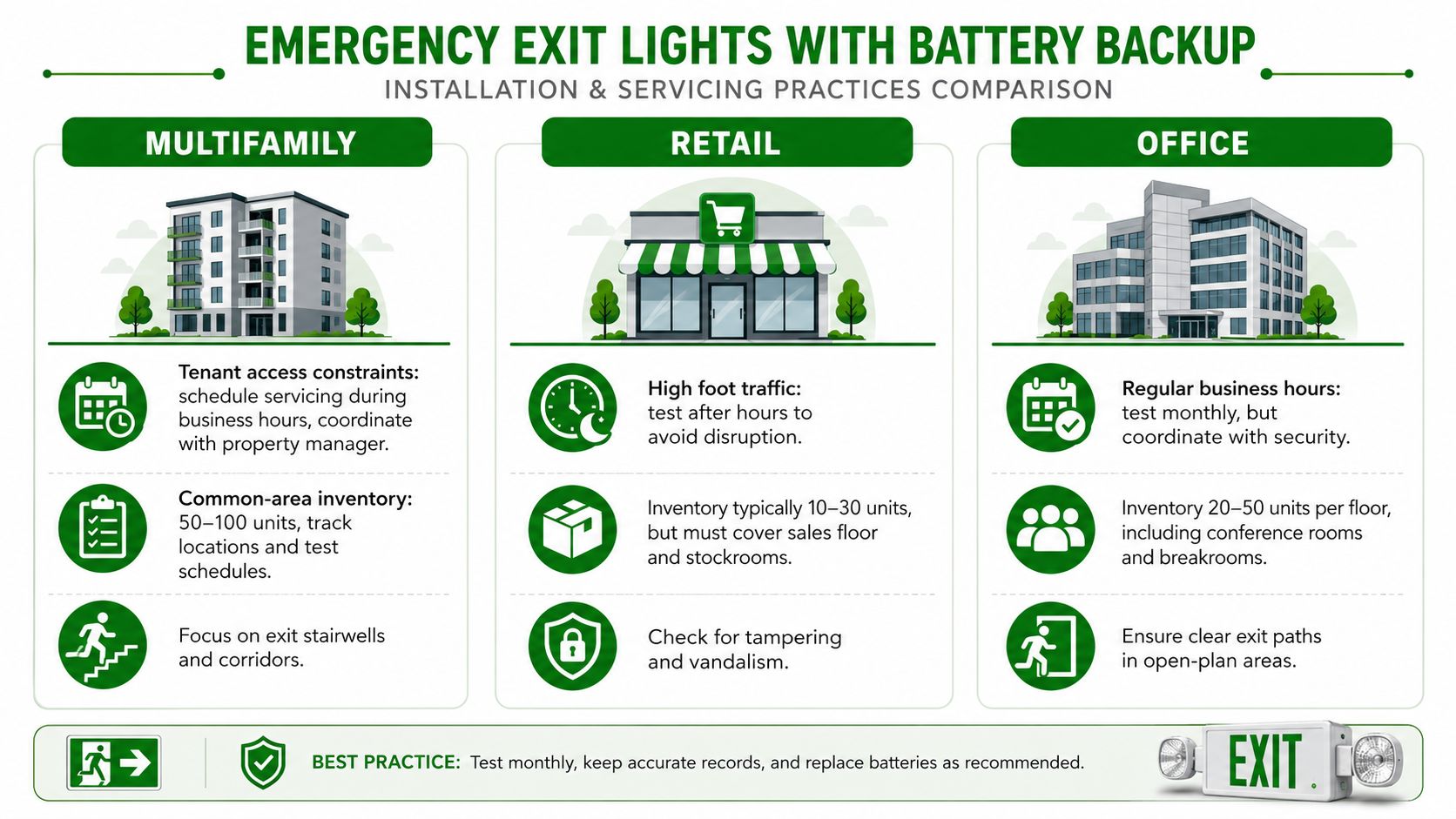
Multifamily, retail, and office buildings all use the same life-safety principles, but the service model changes fast once tenants, operating hours, and access rules enter the picture. The contractor who does well here is the one who plans around access first and hardware second.
Multifamily buildings
In apartments and mixed-use properties, the biggest constraint is tenant access. Common areas may have a large fixture count, but you can't just show up and start testing inside occupied zones without coordination. Pre-labeled fixture maps, a known service route, and a technician who can work around turnover windows make the difference between a clean visit and a rescheduled one.
Stairwells and corridors are usually the focus, because they're the routes residents use under stress. A dedicated service contract makes sense when the building has many fixtures and limited staff time, especially if the manager wants one contact for testing, replacement, and recordkeeping.
Retail and office properties
Retail spaces bring a different set of headaches. Window glare, tenant signage, remodel work, and after-hours access all affect how and when a sign gets tested. High-contrast LED heads and correct mounting height matter because a sign that disappears into the storefront visually might still be listed, but it won't help anybody in an outage.
Office buildings usually need a cleaner schedule. Open-plan areas, conference rooms, breakrooms, and security-controlled access mean testing often happens after hours or with building staff present. In those settings, an annual walk-through with monthly in-house checks works well when the team has a disciplined record process.
The labor model that holds up
The right service model depends on who can access the units, who owns the logs, and how many times a year the building changes hands. Inventory software helps because it ties fixture IDs to locations and service dates instead of leaving everything in a spreadsheet nobody updates.
Access Electrical and Lighting handles emergency lighting installation, testing, maintenance, and repair as part of its commercial electrical scope in Southern California, which is the kind of service bundle many owners need when inspections, repairs, and documentation all land at once.
Building a Compliance Program That Actually Holds Up
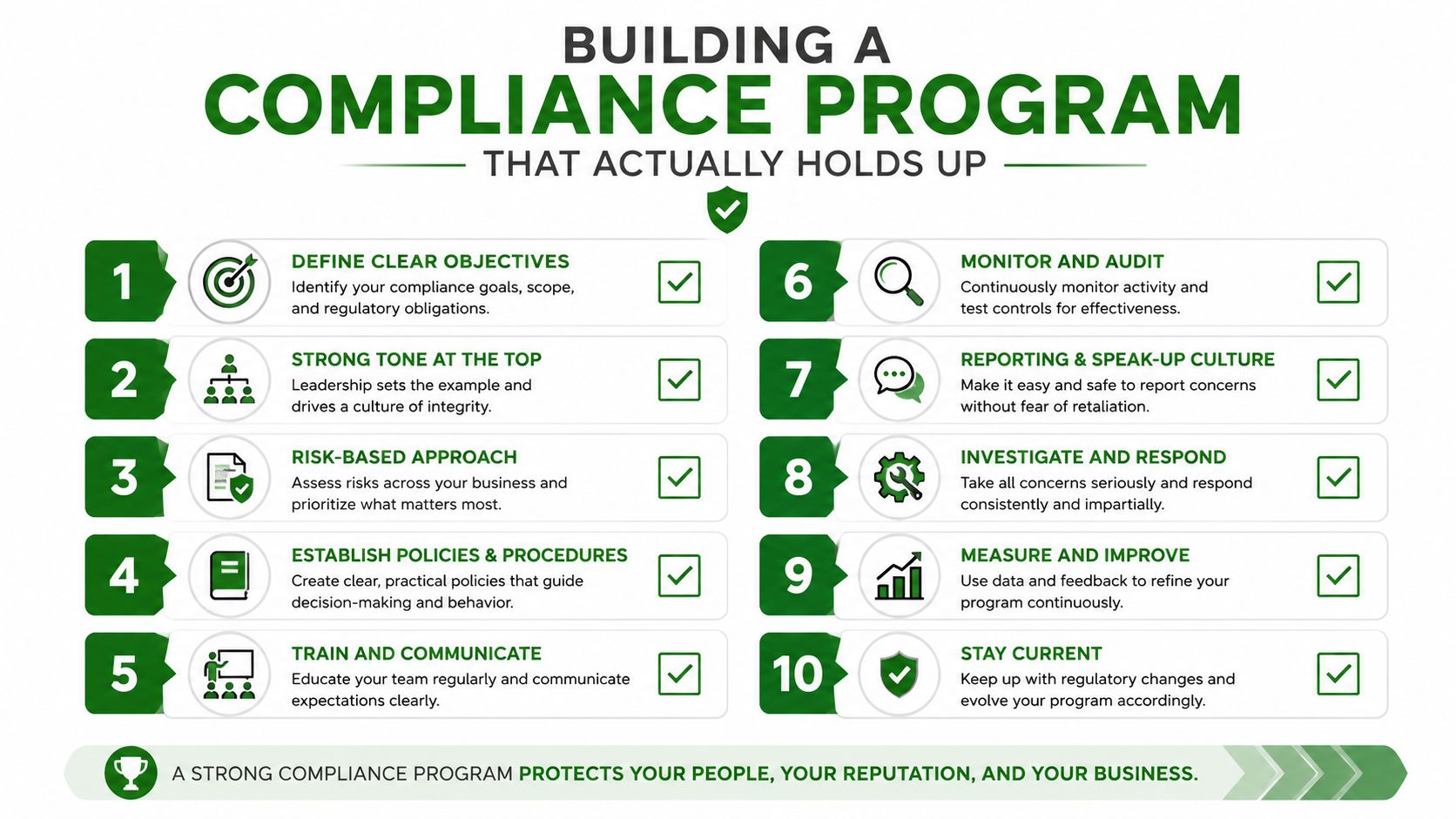
A compliant building doesn't just have emergency lights. It has a program. That means a current fixture inventory, a monthly testing assignment, an annual discharge test schedule, battery age tracking, and a record format that someone can hand to an inspector without scrambling.
What the checklist looks like in practice
The strongest programs are simple enough to maintain during busy months and strict enough to survive an AHJ visit. Keep the following pieces in one system, not scattered across emails and paper notes:
- Inventory documentation with fixture location, type, and install date.
- Monthly functional tests assigned to a person, not a department name.
- Annual 90-minute discharge tests with recorded results by fixture.
- Battery age tracking so replacement happens before failure.
- Condition notes for housings, diffusers, drivers, and status lights.
Older buildings benefit from a one-time reconciliation walk, especially after remodels or tenant changes. Newer self-testing and self-diagnostic fixtures reduce manual labor, but they still need someone to review the fault indicators and close the loop on repairs. That's the difference between automation and compliance.
Why this gets more important, not less
Emergency lighting is moving toward more networked monitoring, more lithium-based battery options, and tighter coordination with energy and life-safety rules. AS/NZS 2293.2:2019 already reflects that shift toward ongoing maintenance management, and U.S. owners should expect the same discipline to keep expanding as codes evolve (AS/NZS 2293.2:2019 product information).
If you want fewer surprises at inspection time, treat these fixtures like any other regulated asset. Assign ownership, schedule the tests, keep the proof, and replace weak units before they become an AHJ problem.
If your property needs emergency lighting testing, battery-backed exit sign repairs, or a clean compliance program that stands up to an AHJ walkthrough, Access Electrical and Lighting can help with installation, maintenance, and documentation across commercial, retail, office, and multifamily sites. Visit Access Electrical and Lighting to schedule service and get your exit lighting program back under control.