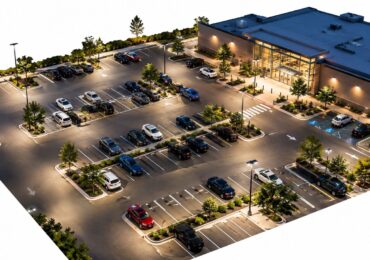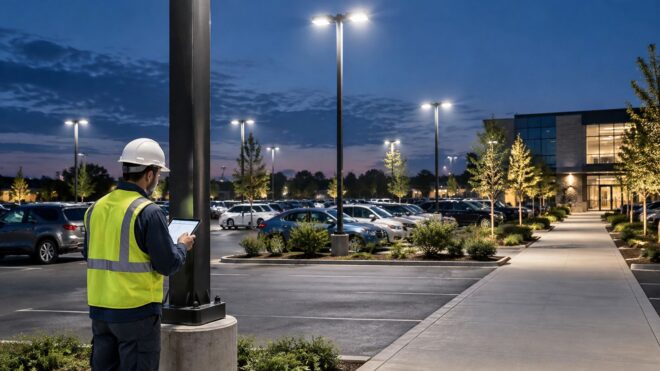
The most common advice property managers get is simple. Swap the old heads for brighter LEDs and the lot will feel safer. That advice fails before a crew ever sets a ladder. A fixture that floods the asphalt under the pole can still leave the walk to the stairwell in shadow, and the glare can hide a person standing just past the beam. A parking lot lighting service is worth the invoice only when it proves visibility, not when it adds lumens.
What you should receive is a measured job. Baseline readings, a layout that hits named light levels, poles that can carry the new fixtures, controls that shut off at dawn, and a retest after the work. Brightness is a byproduct. Even coverage is the product.
Parking Lot Lighting Services at a Glance
A resident complains about a dark corner. The utility bill keeps climbing. An inspector flags a pole that leans after a storm. Each of those calls is a different job, and picking the wrong scope wastes the first mobilization.
Start with the symptom, then buy the service that removes the cause. A dark complaint with healthy poles is usually a light-level and aiming problem. A bill that stays high after lamps were already changed is usually runtime, which means controls. A lean, a cracked grout pad, or rust at the handhole is a structural problem, and new luminaires will not fix it.
The U.S. Department of Energy LED adoption summary put LED penetration in the parking-lot category at 26.2% in 2016, with outdoor uses moving faster than indoor ones. That shift is why most current work is a retrofit plus controls and upkeep, not a lamp swap on a high-intensity discharge head.
| Service | What It Includes | Usual Trigger |
|---|---|---|
| New installation | New poles, luminaires, wiring and photometric layout | New construction, lot expansion or remodel |
| LED retrofit | Replacement LED fixtures, often on existing poles, after a site audit | High energy bills, failing lamps or lighting complaints |
| Pole testing and repair | Base and corrosion inspection, anchor bolt checks, straightening or replacement | Visible lean, cracked base, storm damage or pole age |
| Controls | Photocells, time schedules, dimming and occupancy sensors | Daytime burn hours or high annual runtime |
| Maintenance | Relamping, aiming correction, cleaning and scheduled inspections | Recurring dark zones or aging fixtures |
| Emergency response | Diagnosis and repair of outages, nights and weekends | Outage, safety incident or fault in a dark lot |
Match the call before you write the scope
Use the table as a filter, not a menu.
- Dark corners with lamps that still light: Maintenance first, then a retrofit if the optics cannot hit the far stalls.
- Lamps on at noon: Controls. A photocell or a stuck contactor is burning hours you are paying for.
- A pole that moved: Pole testing before any head replacement. Loading a corroded shaft is how a lighting job becomes a falling-hazard job.
Many properties need two or three rows in one project. A retrofit on rotten bases, or new controls with no night retest, leaves the original complaint in place. Match the symptom to the cause, and put every included service in the written scope.
Performance Targets Every Service Should Measure
A fixture that turns on does not prove the lot is safe. Illuminance is how much light lands on a surface. Uniformity is how even that light is from the brightest point to the darkest. Judge a parking lot lighting service by both, not by how bright one head looks from the office window.
DOE guidance citing IES RP-20-98 sets basic parking lots at a 0.2 footcandle minimum horizontal and a 0.1 footcandle minimum vertical, with a maximum-to-minimum ratio of 20:1. Enhanced-security areas rise to 0.5 fc horizontal and 0.25 fc vertical, and the ratio tightens to 15:1. A wide max-to-min spread leaves dark zones even when the average looks fine, which hurts facial recognition and pedestrian visibility. IES security-lighting guidance.pdf) recommends an average of 30 lux (3 footcandles) on open lots where security is a concern, and 60 lux along sidewalks, footpaths, and surrounding grounds. Those are different criteria. Name the one the property is designing to before anyone orders fixtures. The same targets belong in any written parking lot lighting standards package you ask a bidder to follow.
| Area Type | Horizontal Minimum | Vertical Minimum | Max-to-Min Uniformity |
|---|---|---|---|
| Basic parking lot | 0.2 fc | 0.1 fc | 20:1 |
| Enhanced-security area | 0.5 fc | 0.25 fc | 15:1 |
| Open lot, security concern | 30 lux (3 fc) average | Face-height reading | Even stall coverage |
| Sidewalks and footpaths | 60 lux | Path-height reading | Continuous path coverage |
How a night survey is actually run
Take readings after full dark, on a grid, not under the poles only. Horizontal readings sit on the pavement. Vertical readings face the meter toward the walking direction near entrances, crosswalks, and vehicle conflict points, because pavement light alone does not show whether a person or a cart is visible. While the meter is out, note failed heads, tree cover, banners, and misaimed brackets, and record mounting height and tilt.
Pass rule: An average can clear the target while one stall fails the ratio. The job passes only if the minimums pass, not if the middle of the lot looks bright.
The closeout file should list measured values, fixture locations, what was corrected, and a pass or fail against the criterion you chose. Without that page, you bought hardware, not performance.
Why Brighter Lights Can Make a Lot Less Safe
Brighter is the default upgrade pitch, and it is often the wrong one. The National Park Service outdoor lighting principles state that increasing light output does not necessarily improve nighttime safety and can reduce visibility. DarkSky guidance points the same way. Light should be useful, targeted, no brighter than necessary, and controlled.
Three mechanisms show up on real lots.
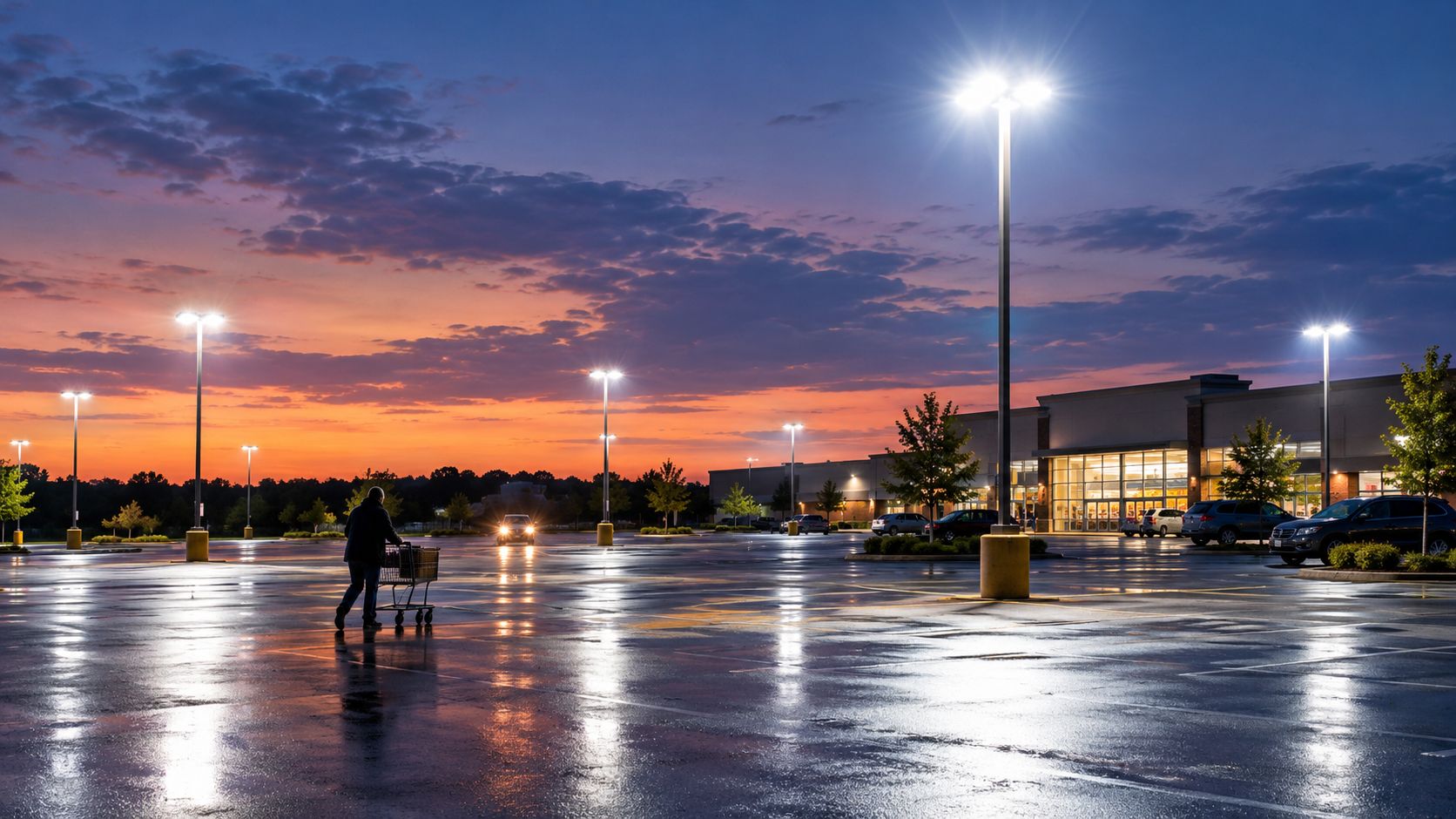
Glare from a bare or poorly shielded luminaire forces the eye to adapt to the source. What sits just beyond the beam drops out of view. High contrast does the same job in reverse. A very bright stall next to a dim one creates a black pocket, and people and obstacles disappear into it. Fixtures aimed at a wall, a neighbor's windows, or into the drive lane blind drivers and pedestrians at the exact point where they need to see each other.
Say a retail center replaces older heads with higher-lumen fixtures on the same poles and the same tilt. Shoppers complain about glare at the cart corrals, and the walkway between the building and the first row stays dark because the new distribution never reached it. Or take a multifamily property with brilliant lot poles and almost nothing on the stairwell approaches. Residents feel exposed on the last thirty feet, which is where most confrontations and trips happen.
Entrances, ramps, and crosswalks are the points that matter. A night audit, a change in mounting height or spacing, shielding, and lower-glare optics will do more than another bump in lumen package. Confirm emergency routes stay lit when dimming is active. The aim is consistent visibility, not a brighter postcard.
How an LED Retrofit Project Runs, Step by Step
Treat the retrofit and the controls as one operating strategy, not a lamp-for-lamp swap. A U.S. Department of Energy parking-lot specification reports potential energy savings of 50% or more versus typical parking-lighting systems, and reported Walmart and Lowe's installations achieved 58% savings relative to ASHRAE Standard 90.1-2010 for an LZ3 application. The same guidance backs photocells so uncovered lot lighting does not run in daylight, plus schedules or occupancy control where use is predictable or intermittent. LEDs add dimming, instant-on, longer useful life, and a more even spread, but only if the design holds the minimums from the night survey.
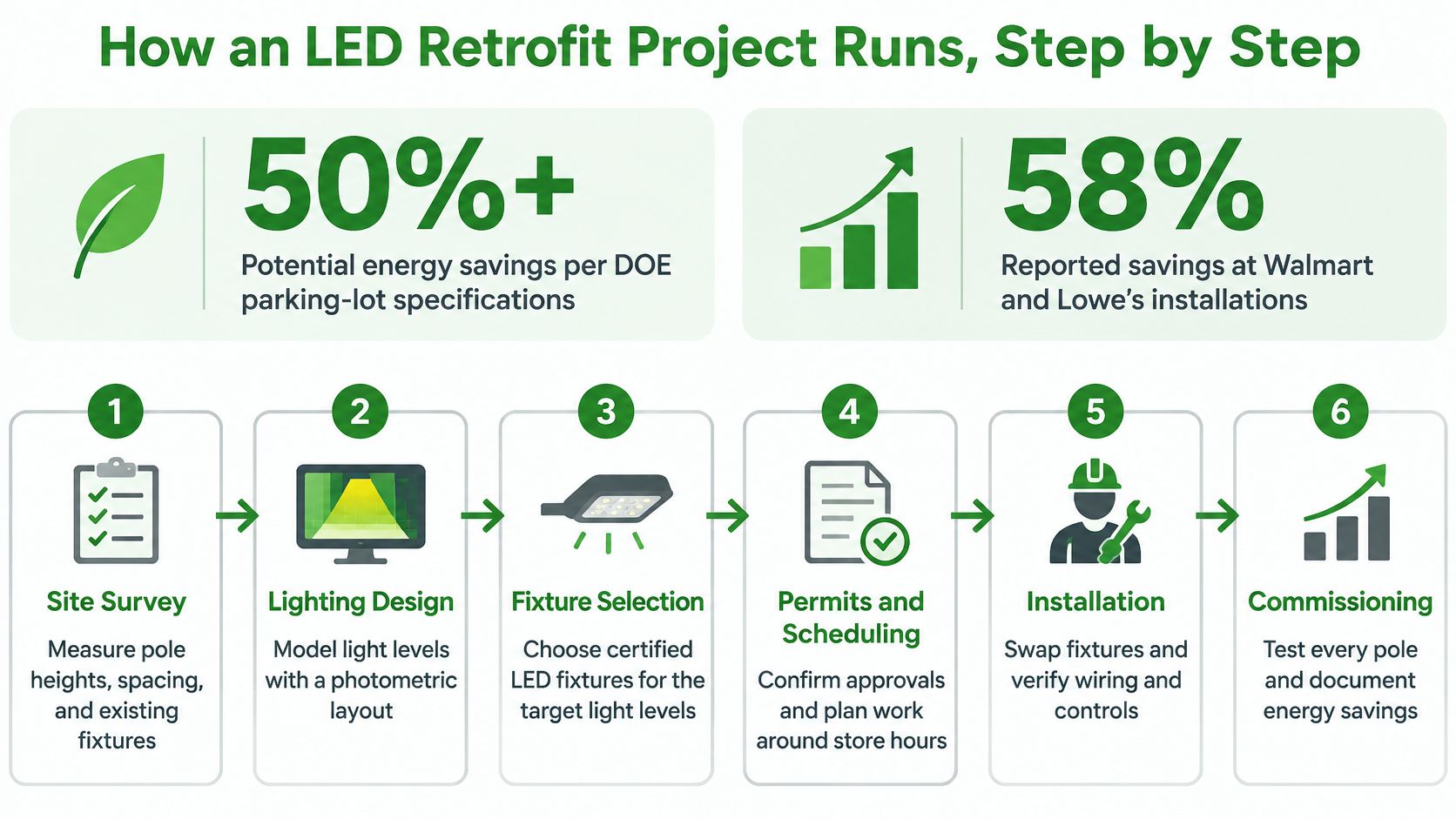
A sound LED retrofit for parking lot lights follows this order.
- Survey what is there. Count fixtures, record wattage, mounting height, annual runtime, and pole condition. Savings math without runtime is a guess.
- Read the lot at night. Grid points become the baseline you are not allowed to worsen.
- Model the new layout. Pick optics, spacing, and mounting height that meet the chosen minimums at lower watts. If the model only works by overlighting the poles, the optics are wrong.
- Check the bones. Poles, wiring, and the existing photocell have to accept the new drivers. A compatible socket is not the same as a sound shaft.
- Hang, aim, and lock. Set the tilt, then mark it so the next relamp does not "improve" it by eye.
- Commission the controls. Prove the photocell kills daytime operation. Set dim levels, schedules, sensor coverage, and an emergency override that brings light back.
- Retest, then hand over. Illuminance and uniformity again, plus the photometric report and warranties. Acceptance sits on this step.
Poorly commissioned sensors and schedules create dark patches, nuisance cycling, and security complaints. I would not sign substantial completion until step 7 is in the file.
Pole Testing, Repair and Ongoing Maintenance
Poles fail without warning. Corrosion at the base, loose anchor bolts, and cracked handholes often show nothing until a lean appears or a storm finishes the job. New LED heads are lighter than many old shoe-boxes, but they still sit on a shaft and a foundation that may be decades old. Skipping the base inspection to save a day is how a lighting upgrade becomes a knockdown.
Pole integrity testing covers the base, the grout, the anchor bolts, and the handhole, plus a check for section loss you cannot see from the drive lane. A boom truck lets a technician reach the head and the pole top without scaffolding on an active lot. Infrared thermography is the matching electrical check. A scan of panels, splices, and drivers finds hotspots before they open a circuit at 9 p.m. on a Saturday.

Use this cadence as a planning reference, and shorten it on the coast, in high wind, or on poles past their rated life. Why that cadence matters is laid out in this note on light pole maintenance and repairs.
| Check | Typical Interval | What It Catches |
|---|---|---|
| Visual fixture and lens check | Monthly or quarterly | Outages, cracked lenses and new dark zones |
| Photometric re-test at grid points | Annually | Light loss over time and misaimed fixtures |
| Infrared scan of panels and connections | Annually | Hotspots and loose connections |
| Photocell and timer function test | Twice a year | Daytime burn hours and failed night operation |
| Pole base and corrosion inspection | Every 2-3 years | Base corrosion, loose anchor bolts and cracks |
What the maintenance report owes you
Photos of each defect, the meter or camera readings, a ranked repair list, and a replacement forecast for the next budget cycle. "Pole looks okay" is not a report. A shaft you will need to replace in eighteen months should be on paper now, while you can schedule a foundation instead of reacting to a lean.
How Long Each Project Phase Takes
For one lot of roughly 50 to 150 stalls, plan on about four to ten weeks from the first night survey to handover. Permits, utility coordination, and fixture lead times move that span more than the install crew does.
| Phase | Typical Duration | What Can Extend It |
|---|---|---|
| Site survey and baseline readings | 1-2 days on site | Large lots and restricted access hours |
| Design and photometric layout | 1-3 weeks | Client revisions after design review |
| Fixture procurement | 1-6 weeks | Lead times and custom optics |
| Permits and inspection scheduling | 1-4 weeks | Municipal backlog and utility coordination |
| Installation | 1-5 days | Pole replacements needing new foundations |
| Commissioning and retest | About 1 day | Control setup and re-aiming |
| Documentation and handover | 3-7 days | Completeness of test records |
Three delays eat calendars.
New foundations turn a one-week hang into a concrete cure and a second inspection. Night-only work around open tenants stretches five install days across two weeks. A redesign after the first photometric review restarts procurement if the optics change.
Ask for a written schedule that names the phase holding the job. It is usually fixture procurement or permit sign-off, not the night the truck is on site.
If a bidder's total is "three weeks" with no phase split, you cannot tell whether they have stock or whether they are hoping the city is fast.
Confirm the Scope Before You Sign a Contract
The decision is narrow. The scope in the contract has to name the services you are buying and the light levels those services must hit. A lump sum for "LED parking lights" does not do that.
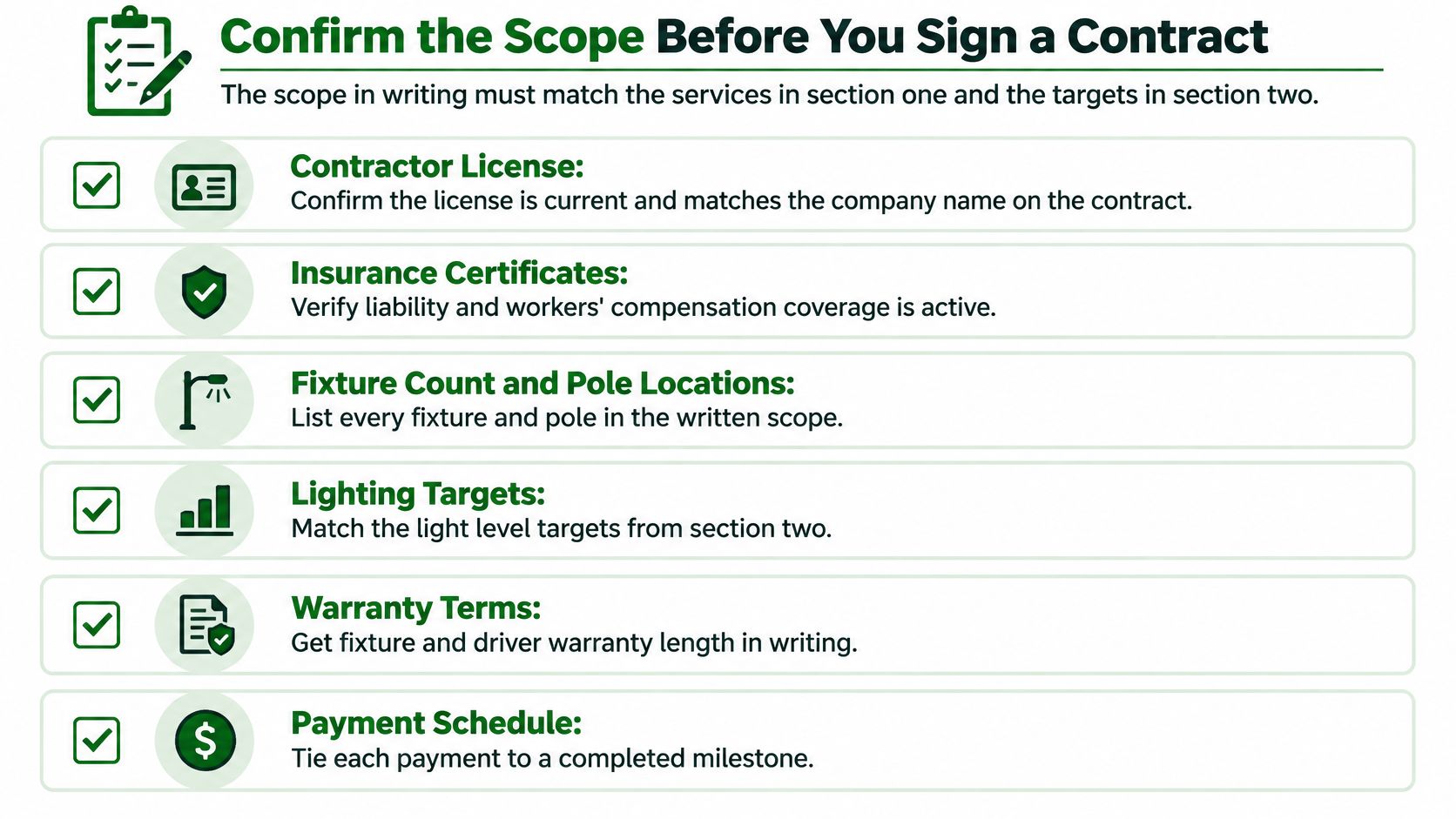
Verify these items before you sign.
- License and coverage. In California, the classification that matches this work is a current C-10 electrical license, plus bonding and insurance certificates in the company's name.
- A written baseline. Measured readings, not a walk-through note that "the lot is dim."
- A retest commitment. Post-installation numbers against the criterion you named, with a pass or fail.
- Warranties. Fixture and labor, in years, and who you call when a driver fails.
- Pole evidence. Photo-documented base and bolt checks, not a verbal all-clear.
- After-hours terms. Response window for a dark lot, and what that visit includes.
- Similar-property references. Multifamily, retail, or office lots, not a single interior relamp.
One contractor that packages this scope is Access Electrical and Lighting, a licensed and bonded California C-10 firm covering Orange County, the Inland Empire, and San Diego, with 24/7 emergency response, infrared inspection reports, Title 24 documentation, and high-reach equipment for poles. Compare that list with any other bidder on the same line items.
Pricing is what most managers ask first, and no single rate fits every property. Fixture count, mounting height, poles that need new foundations, control scope, permits, and night-only work on an occupied lot each move the number. Make every bidder itemize those lines so you compare scope, not a headline total.
Send the lot plan, pole count, current fixture type, runtime or utility bills, and the security concerns. Request a baseline survey and a written scope back. That package is what a parking lot lighting service should start from.
Access Electrical and Lighting installs, retrofits, and maintains commercial parking lot lighting, including controls, pole testing, infrared inspections, and after-hours repairs for Southern California properties. If you want a baseline survey and a scope tied to measured light levels, visit Access Electrical and Lighting and send your lot plan.