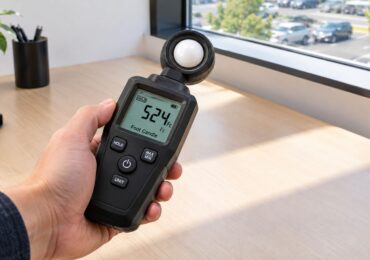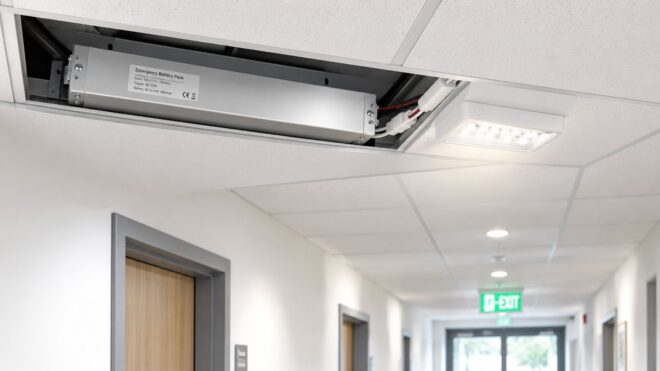
Emergency lighting battery packs must energize within 10 seconds of a power outage and provide at least 90 minutes of illumination. Those requirements make the battery pack a life-safety component, not a convenience accessory or a routine lighting upgrade.
A commercial property can lose normal power with almost no warning. In an Orange County office, retail center, apartment community, or parking structure, the first visible signs may be exit signs going dark, emergency heads failing to ignite, or a corridor becoming difficult to traverse. During an evening outage, occupants may be moving toward stairwells and exits at the same time that security staff, tenants, and first responders are trying to understand what happened.
The fixture may look simple from the floor, but its emergency lighting battery pack has to charge continuously, detect a power failure, transfer the emergency load, and sustain useful illumination under discharge. The right choice depends on more than amp-hour capacity. Battery chemistry, operating temperature, LED load, wiring architecture, testing access, and documentation all affect whether a system passes inspection and works when people need it.
Why Emergency Lighting Battery Packs Matter
At night, a power failure in an Orange County office, retail center, apartment community, or parking structure can turn a routine electrical problem into an evacuation hazard. Corridor lighting disappears, elevators may stop, and occupants lose the visual cues that point toward stairs and exits. The emergency lighting battery pack supplies the light that keeps the egress route recognizable while people move out of the building.
Under UL 924 and NEC emergency lighting requirements, emergency lighting must activate within 10 seconds after normal power fails and remain illuminated for at least 90 minutes. Unit equipment is a complete enclosed assembly with a rechargeable battery, charging means, lamp provisions, and an automatic relay that transfers the lamps to emergency operation.

The pack is judged by sustained output, not just by whether the lamps turn on. Unit equipment batteries must maintain at least 87.5% of nominal battery voltage for 1.5 hours, or provide at least 60% of initial emergency illumination for 1.5 hours, under the same code guidance. A fixture that passes a brief walkthrough can still fail an annual discharge test because the battery has lost usable capacity.
The practical liability
Facility teams often find weak emergency lighting during an inspection, after a tenant complaint, or during an unplanned outage. At that point, a failed pack may require ceiling access, lift equipment, replacement parts, and after-hours labor. The installation architecture also affects those costs. A battery built into each fixture may simplify one repair but multiply the number of service points, while a remote pack can reduce fixture count yet add wiring, access, and troubleshooting considerations. Battery chemistry, operating temperature, LED load, wiring architecture, testing access, and documentation all influence inspection results and the cost of keeping a property compliant.
The wider market reflects broad commercial use. Because market definitions differ, one estimate values the category at USD 7,251.2 million in 2024 and projects USD 14,679.0 million by 2031, while a narrower estimate places it at USD 2.8 billion in 2024 and USD 4.9 billion by 2033, as reported in emergency lighting battery market estimates. The figures are not directly comparable, but both describe an established equipment category.
Practical rule: Treat every emergency lighting battery pack as a life-safety asset with a test history, not as a disposable part hidden inside a light fixture.
Integral versus Remote Battery Configurations
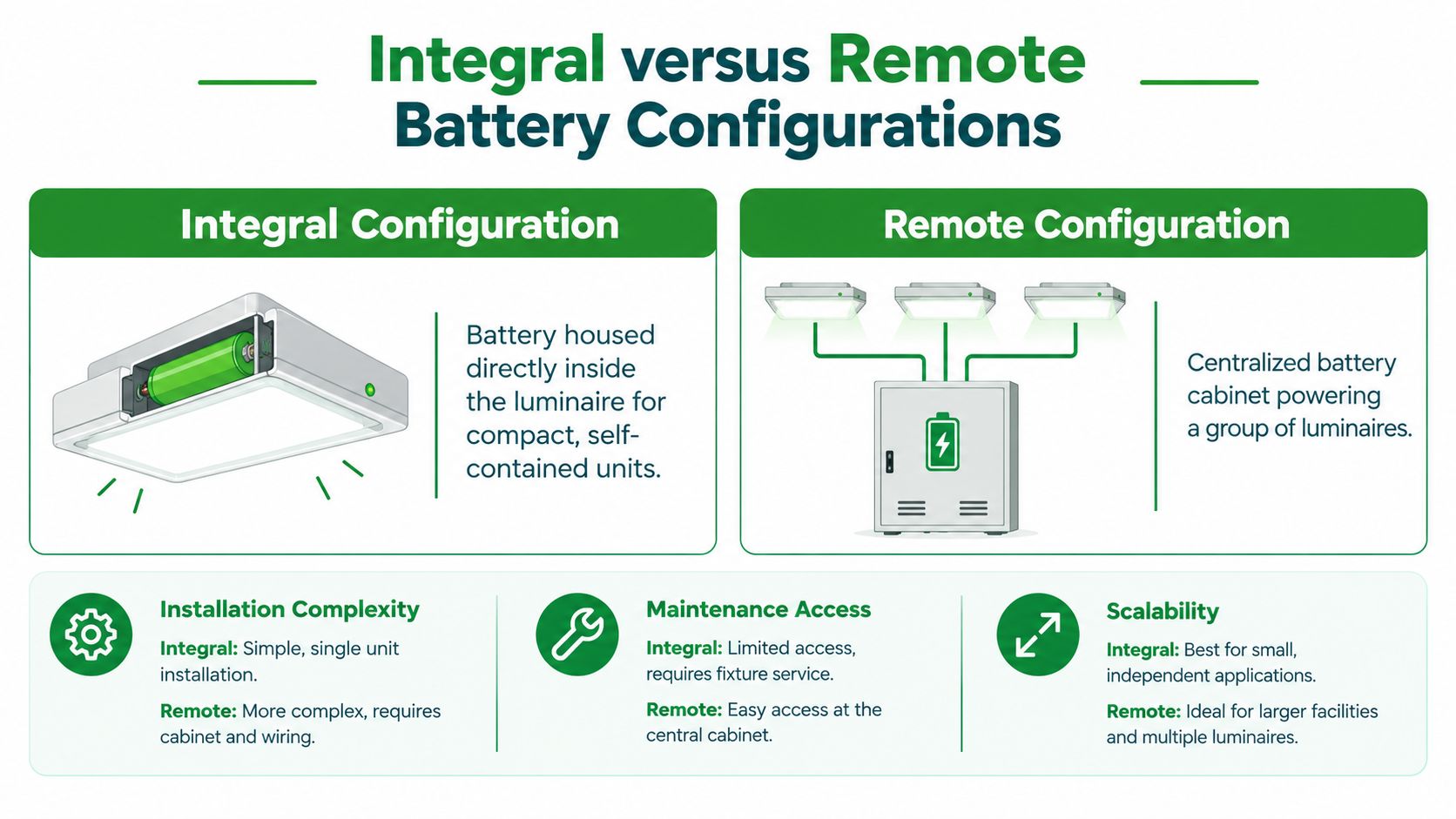
The physical location of the battery determines much of the installation and maintenance strategy. An integral configuration places the rechargeable battery, charger, transfer circuitry, and emergency lamps inside one luminaire. A remote configuration places the battery pack away from the light head and sends emergency power through conductors to one or more remote heads or compatible fixtures.
Integral systems
Integral units are straightforward for smaller offices, corridors, tenant spaces, and areas where the fixture can be reached without major disruption. Each luminaire operates as its own self-contained system, so a technician can test the unit at the fixture and replace the battery without tracing a long emergency circuit.
The trade-off is quantity. A large multifamily property or shopping center may have many individual packs, each with its own battery, charger, status indicator, and test switch. Batteries may also be installed above occupied spaces, inside tight ceiling cavities, or in finished areas where access takes longer than expected.
Integral equipment works well when:
- The building layout is distributed: Fixtures are spread across short corridors, suites, and small rooms.
- Maintenance access is simple: Staff can reach the test button and battery compartment safely.
- The emergency load is modest: The internal pack is matched to the fixture rather than a larger group of heads.
- Independent operation matters: A failure affects one unit instead of a group supplied by one central pack.
Remote systems
Remote battery packs can concentrate service work in an accessible electrical room, utility space, or designated cabinet location. One pack may supply several compatible emergency heads, which can reduce the number of battery locations and make centralized testing easier. This approach can suit large retail interiors, parking structures, multifamily common areas, and commercial renovations where fixture replacement should not require replacing a battery in every luminaire.
Remote systems require more design discipline. The installer must verify the pack's output, connected load, conductor sizing, distance, voltage drop, polarity, and compatibility with each remote head. A poorly planned run can leave a head underpowered even though the central battery cabinet appears healthy.
| Configuration | Strength | Common concern |
|---|---|---|
| Integral | Simple, self-contained installation | Many separate batteries to inspect and replace |
| Remote | Centralized access and group coverage | Wiring, load, distance, and compatibility must be verified |
| Integral LED retrofit | Convenient for individual fixture upgrades | Limited space and heat can affect the pack |
| Remote LED retrofit | Flexible placement and centralized service | A single pack failure may affect multiple heads |
LED retrofits add another consideration. The emergency lighting battery pack must match the actual LED driver load and output window. A pack selected only by battery amp-hour rating can energize a fixture but still fail to deliver the intended emergency wattage for the required duration.
Battery Chemistry and Lifespan Choices
Battery chemistry determines how a pack behaves in heat, cold, repeated testing, storage, and long-term service. The two choices most often evaluated for modern commercial emergency lighting are lithium iron phosphate, or LiFePO4, and nickel-cadmium, or Ni-Cd.
LiFePO4 packs can offer efficient cycling, low self-discharge, and a compact design. Tridonic datasheets specify LiFePO4 cells at 3.2 V, with capacities of 1.5 Ah or 3.3 Ah, and a design life of up to 8 years at +25 °C, dropping to 6 years at +35 °C, as shown in the LiFePO4 emergency battery documentation. The longer-life rating is associated with a controlled ambient range typically limited to +5 to +25 °C.
That distinction matters in real properties. A battery installed in a conditioned office ceiling doesn't face the same aging conditions as one installed above a hot mechanical room, inside a sun-exposed service area, or near equipment that continuously raises ambient temperature. A longer design life on a product sheet won't compensate for an installation environment outside the battery's intended range.
Where Ni-Cd still makes sense
Ni-Cd packs remain useful when temperature tolerance carries more weight than compact size or energy efficiency. One 4.8 V, 4 Ah emergency pack is marketed for operation from -20 °C to +70 °C with a minimum 4-year life, according to the available product specifications. That makes this chemistry worth evaluating for unconditioned parking structures, exterior equipment areas, and spaces with wider temperature swings.
A different emergency pack specification lists operation from 20 °C to 55 °C and a 90-minute illumination duration, showing why the complete product rating matters more than chemistry alone. Two packs with similar nominal capacity may behave differently because their cells, control boards, enclosure, thermal conditions, and connected LED load differ.
Match the pack to the LED load
Modern LED packs commonly use universal AC input and constant-power emergency output. One commercial product example accepts 120 to 277 VAC at 50/60 Hz, senses the required LED voltage, and provides either 7 W or 14 W of constant power for at least 90 minutes, with low-voltage disconnect to limit deep discharge, according to the Sure-Lites LED emergency battery pack specification.
That architecture is important because LED loads aren't fixed-resistance loads. Forward voltage and temperature change during operation, so constant-power regulation can preserve illumination more predictably than a simple voltage-limited backup circuit. Before approving a replacement, verify the driver load, input range, emergency wattage, output voltage window, temperature rating, and required duration. Product information on exit sign battery selection can help organize that review, but the installed fixture and driver remain the final compatibility check.
Testing and Maintenance Requirements
A battery pack is only reliable if the facility can prove that it operates under test. The practical maintenance mistake is treating a quick lamp check as evidence of battery health. A short functional test confirms that the transfer circuit and lamps respond. It doesn't prove that the battery can carry the emergency load through the full discharge period.
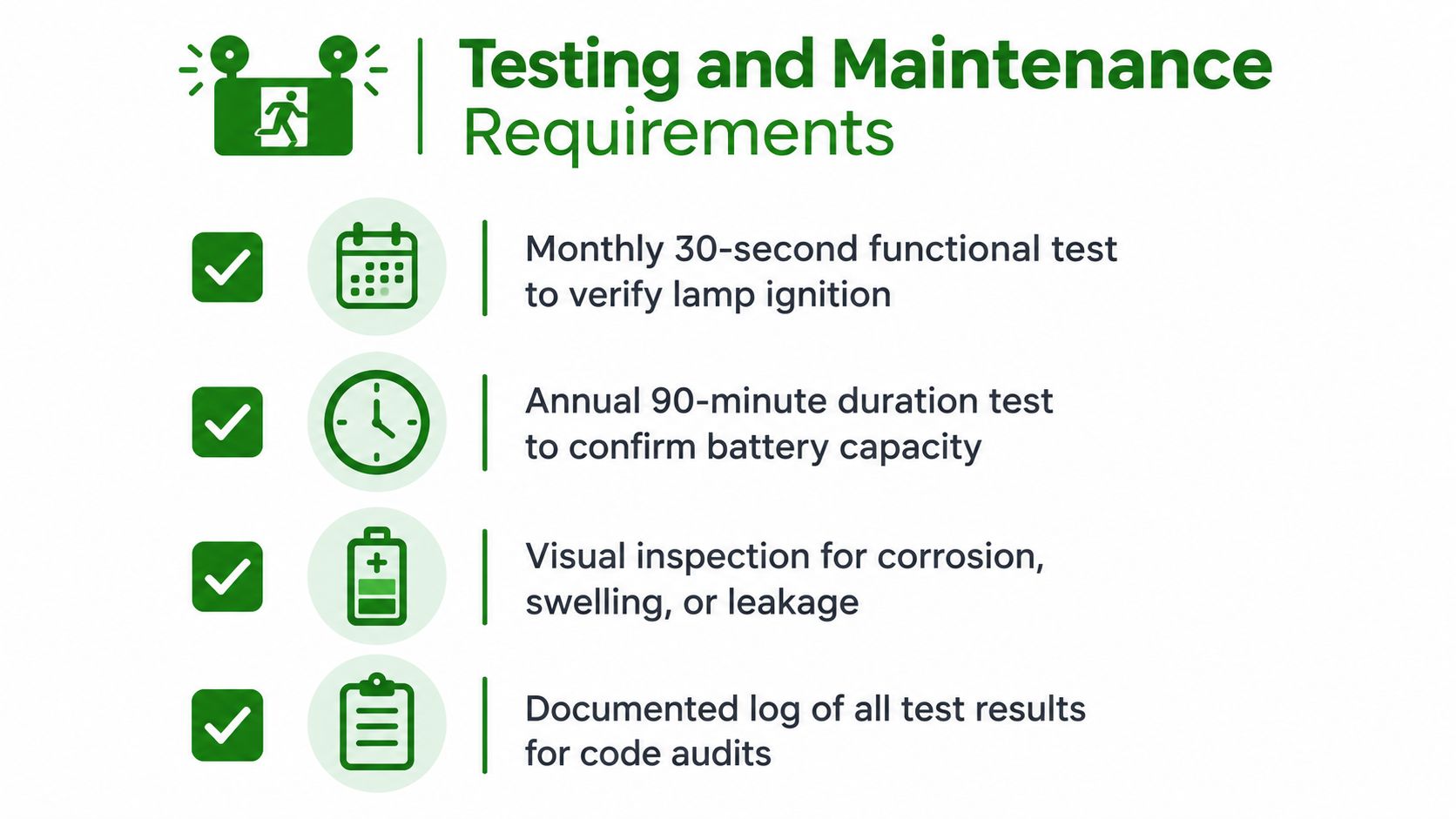
Self-contained battery-pack fixtures generally require a 30-second monthly functional test and a 90-minute annual discharge test, as summarized in emergency lighting inspection and testing guidance. Central battery systems follow a different inspection, testing, and maintenance schedule under NFPA 111, so facility staff shouldn't apply one architecture's procedure to the other.
Monthly functional testing
A responsible monthly check should be controlled and documented rather than performed as an informal walk-through.
- Identify the unit: Record the fixture location, asset identifier, and configuration.
- Initiate the test: Use the local test switch or approved test method to interrupt normal power.
- Watch the transfer: Confirm that emergency lamps energize promptly and that the status indicator behaves normally.
- Check the light path: Look for dark heads, weak output, poor aiming, or obstructions along the egress route.
- Record the result: Note the date, tester, unit condition, and any corrective action.
A unit that fails to transfer, shows a fault indicator, produces visibly weak light, or has a damaged test switch should be tagged for follow-up. Don't reset the indicator and close the work order without identifying why it failed.
Annual discharge testing
The annual test puts the battery under the condition that matters most, sustained emergency operation. Confirm the normal lighting circuit is restored afterward, verify that the pack recharges, and document units that fall short of the required duration or show declining illumination during the test.
Inspection staff should also look for swelling, corrosion, leakage, damaged conductors, loose connections, overheated components, and inaccessible test points. A battery can pass a brief ignition check while showing physical deterioration that warrants immediate replacement.
A complete test log should tell the next technician what happened, where it happened, and what was done about it.
The commercial emergency lighting testing service should include more than pressing buttons. It should connect fixture identification, test results, observed defects, replacement recommendations, and closeout documentation so the property team can track recurring failures across a site.
Navigating Title 24 and NEC Compliance
A battery pack may work during a brief service check and still leave an Orange County property exposed during an inspection. California commercial properties must satisfy applicable NEC installation requirements, while the project or facility may also require Title 24 testing, certification, and documentation. The equipment, testing method, and records must support the same compliance story.
The 2023 NEC added Section 700.12(H) for battery-equipped emergency luminaires. Battery-supported emergency lighting has also appeared across multiple NEC code cycles, so renovation work often brings older drawings, legacy fixtures, and newer LED equipment into the same property. Review the applicable NEC emergency power requirements before approving a replacement or documenting an installation.
Build the compliance record during service
A useful record connects each unit to the building and to its operating history. Include:
- Location and identification: Record the floor, room, corridor, parking level, or exterior area.
- System architecture: Identify an integral pack, remote pack, or central battery system. This affects access, replacement labor, and how failures appear during inspection.
- Test result: Document functional operation, discharge performance, lamp condition, and status indicators.
- Battery information: Record chemistry, model, replacement date, and visible deterioration.
- Corrective action: State whether the unit passed, failed, was repaired, or requires scheduled replacement.
- Closeout evidence: Keep technician notes, useful photographs, and confirmation that normal power was restored.
This level of detail helps facility managers separate an isolated battery failure from a wider pattern caused by heat, incompatible LED drivers, poor access, or an aging product family. It also gives an inspector something more useful than a generic statement that emergency lights were checked. Architecture matters here: a remote pack may reduce fixture heat but add wiring and access points, while an integral pack may simplify installation but make future servicing more disruptive.
Avoid code assumptions
A replacement is not compliant just because it fits the existing cutout. Verify the listing, emergency output, input range, environmental rating, mounting arrangement, and compatibility with the luminaire. For California projects, coordinate electrical work with the applicable Title 24 scope and retain the certification or test records required by the project team.
For a fuller breakdown of the applicable requirements, see our guide to emergency lighting code requirements. Design review, installation, testing, repairs, and recordkeeping should operate as one process, with shared documentation that remains available to the property team and the inspector.
When to Replace and Upgrade Your Packs
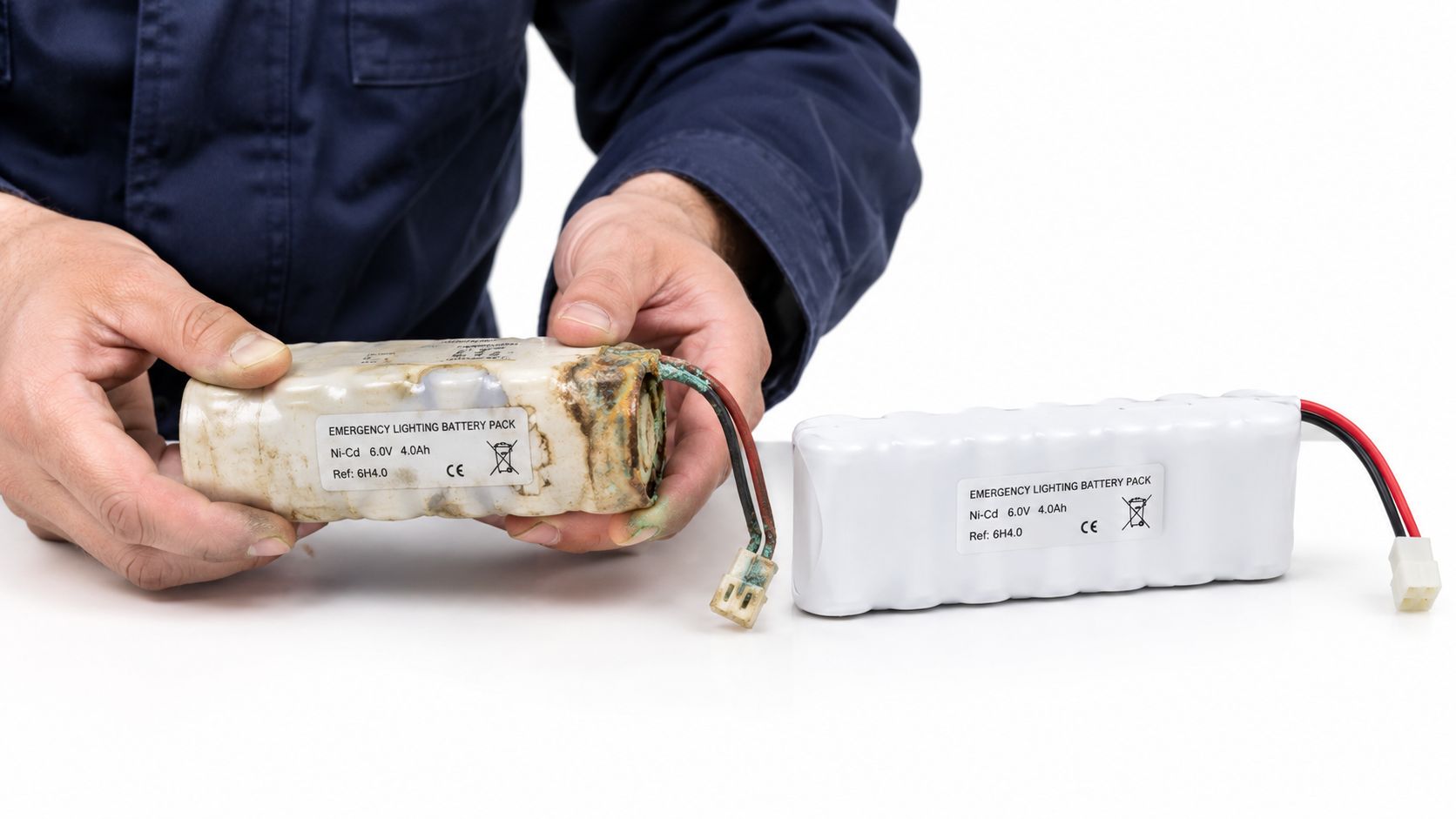
A battery pack should be replaced before it becomes an emergency during an outage. The clearest trigger is a failed or marginal duration test, but technicians should also act on swelling, leakage, corrosion, repeated fault indications, damaged wiring, poor recharge performance, and a history of recurring failures.
A pack that barely completes a test isn't a comfortable pass for a busy property. Its condition can deteriorate further before the next scheduled inspection, especially when it operates in a warm or poorly ventilated location. Waiting for total failure also tends to create rushed purchasing, mismatched replacements, and avoidable access costs.
Use lifecycle evidence
Owners comparing legacy sealed lead-acid or Ni-Cd equipment with LiFePO4 should evaluate more than the purchase price. The relevant questions are:
- How often does the existing chemistry fail its discharge test?
- Does the installation expose the pack to heat or cold?
- Can technicians reach and replace it without disrupting tenants?
- Does the new pack match the LED driver and emergency wattage?
- Will centralized monitoring reduce the chance of an unnoticed failure?
- Are replacement parts and compatible fixtures available for the planned service period?
Market coverage identifies lithium-ion as a growing part of the category because of energy density, recharge behavior, self-discharge characteristics, and service-life potential. One 2026 market estimate places lithium-ion at 45.8% share, while the same market discussion notes that wireless condition monitoring and predictive maintenance features are increasingly bundled into some packs, as described in emergency lighting battery market coverage. That figure is a market estimate, not a guarantee for any particular facility.
The best upgrade is the one that fits the environment and produces a defensible maintenance plan. A compact LiFePO4 pack may be a sensible choice in a controlled interior space, while a higher-temperature-certified Ni-Cd design may be more practical in an exposed parking or mechanical area. Replace by condition and application, not by chemistry trend alone.
Key Takeaways for Property Owners
An emergency lighting battery pack has two jobs that facility teams must verify. It must transfer quickly when normal power fails, and it must continue supporting the connected emergency load for the required duration. Product labels, nominal capacity, and a successful brief lamp check don't replace a properly matched system and a documented discharge test.
For an Orange County commercial property, the most useful review starts with the installed environment and architecture:
- Map the system: Identify integral fixtures, remote packs, central battery equipment, exit signs, and emergency heads.
- Check the load: Match the pack to the LED driver, emergency wattage, output range, and fixture configuration.
- Review the environment: Account for heat, cold, moisture, dust, impact exposure, and service access.
- Test consistently: Perform the monthly functional check and annual full-duration discharge test required for the applicable system type.
- Keep records: Link every result to a fixture or pack so failures and replacement patterns are visible.
- Replace proactively: Schedule weak, swollen, leaking, or repeatedly failing batteries before they create an outage or inspection emergency.
- Coordinate compliance: Keep NEC, Title 24, installation, testing, and corrective-action records together.
Chemistry affects lifecycle cost, but architecture affects labor and failure impact. An integral pack may be easy to understand but difficult to service across a large property. A remote pack may improve access and scalability but demands careful load and wiring verification. The right decision balances safety, environmental conditions, maintenance access, replacement planning, and inspection evidence.
Access Electrical and Lighting provides commercial emergency lighting and exit sign installation, testing, repair, and battery-backup maintenance for Orange County properties. Visit Access Electrical and Lighting to request a system review, schedule testing, or plan battery replacements around your facility's compliance and maintenance needs.